
Princess and ‘The Pitt’
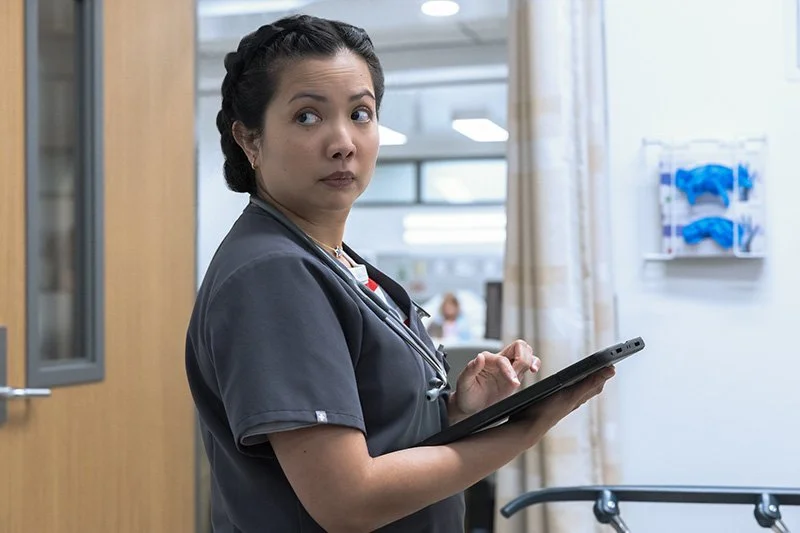
Kristin Villanueva as Princess Dela Cruz in HBO Max’s “The Pitt” (Photo by Warrick page/HBO Max)
Kristin Villanueva stars as Princess Dela Cruz, the horny nurse in the Emergency Department (ED) of the fictional Pittsburgh Trauma Center (PTC) in The Pitt on HBO Max, which won the 2026 Actor Award for Outstanding Performance by an Ensemble in a Drama Series. (“Horny” is Villanueva’s own description.) But in real life, she once encountered a response that many Filipinos would find almost unthinkable—from a Filipino nurse who could have rescued her from a long wait.
A Life-or-Death Emergency
Any benefit a Filipino nurse can confer would be informal or under the scanner. Villanueva learned, however, that some Filipino nurses ignore the unwritten doctrine when she sought compassion for a friend who was suffering from renal colic.
The Pitt is known for graphic realism in its depiction of surgical procedures, such as sternotomies, and for its rapid-fire jargon. If you’re in the show’s fan base, you probably know “renal colic” is the medical term for a painful kidney stone like the one Villanueva escorted her friend to the hospital to treat. While passing a stone isn’t a code blue emergency, we know from The Pitt that any illness can take a wrong turn and become a life-or-death struggle. I’ll let her tell the story.
“We were in the waiting area for 30 minutes. Now that I’m doing The Pitt, I know 30 minutes is nothing, right?” Villanueva alludes to the perspiring extras who sit in eternal agony in the hellish waiting room of each episode. “You feel so helpless when you’re watching your friend go pale. She was holding onto a trash bag just in case she vomited.”
“I didn’t know what to do until I spotted two Filipino nurses down the hall speaking to each other in Tagalog. I told my friend, ‘Give me a second.’”
For the sake of her friend, Villanueva invoked a tacit agreement that binds all Filipinos. “So, I went up to them and I spoke in Tagalog. When I speak Tagalog,” she clarifies, “I don’t have an American accent.”
“I know that you have a long line. We don’t mind waiting,” she explains to the more sympathetic of the two nurses. “But if we could just get something like a stronger Tylenol to ease her pain, that would be appreciated.” She repeats, “I said this in Tagalog. And this Filipino nurse looks me in the eye and answers me in English: ‘She has to wait for the doctor.’ And then the nurses walked away.” So much for the preferential kababayan treatment.
Villanueva assures me that the two nurses’ resistance to cultural nepotism didn’t have tragic implications for her friend.
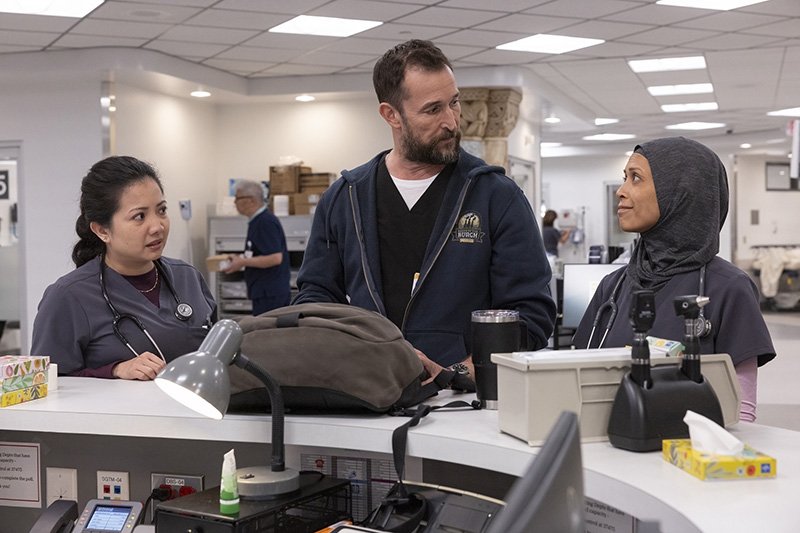
Kristin Villanueva, Noah Wyle and Amielynn Abellera (Photo by Warrick page/HBO Max)
Musical Theatre: First Employer of Filipino Actors
At age 15, Kristin immigrated from Manila to Washington, DC, with her mother, Carolina. She performed in Singin’ in the Rain in high school and had intended to study at Syracuse University because of its reputable musical theatre program. But the school’s $37,000-a-year tuition was unaffordable.
“So, I ended up at SUNY (State University of New York) Purchase, which has just a straight acting program,” she recalls of the second door that opened after the first one closed. “It was actually a great fit.”

Kristin in the Philippines
For a list of productions that featured Villanueva, please view her résumé on her website at kristinvillanueva.com/bio. Missing from her résumé is her contribution to the first two workshops in the development of Here Lies Love at The Public Theater in New York City. (I know this exclusively from my interview, so don’t say Positively Filipino only repeats news mined by other publications.)
Villanueva’s résumé shows that her live performances on stage outnumber her performances in film and television. Nebraska Shakespeare Festival’s production of The Two Gentlemen of Verona: The Musical is closest to her heart. “While it’s based on the Shakespeare play, it’s done by the same composers of Hair,” she says of the 1960s rock musical that featured the music of Galt MacDermot. “You can imagine how groovy it was.”
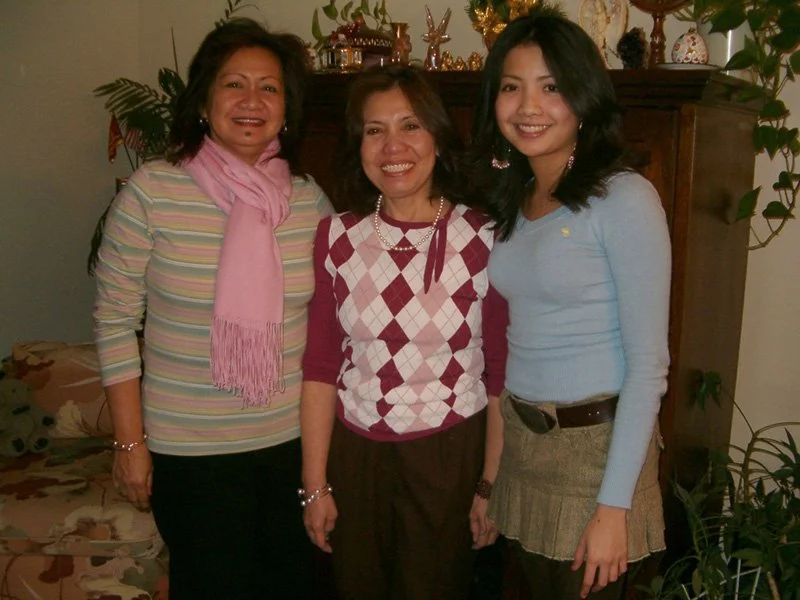
Kristin in high school in Virginia with her mom and aunt
A Princess for All Filipino Nurses
Within the great ensemble of The Pitt is the small yet trailblazing group of Filipina actors: Villanueva, Isa Briones (Dr. Trinity Santos), and Amielynn Abellera (Perlah Alawi).
It’s about time. Ever since World War II, Filipinos have often been the first health care employees that patients see when they enter city hospitals. Yet they have hardly been depicted in film and television. In this respect, seeing them portrayed on screen in 2026 corrects more than 80 years of erasure. But to restate the obvious, it’s not the actor’s job to correct historical injustices. Villanueva and her castmates can only focus on their individual parts. It’s up to audience members to endow characters with universal meaning. Villanueva’s Princess is a single character and not a composite of all Filipino nurses.
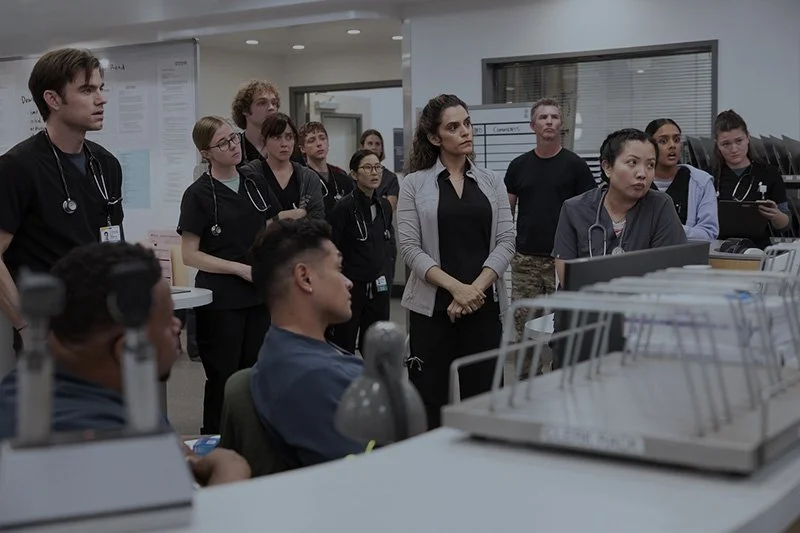
(L-R) Patrick Ball, Taylor Dearden, Fiona Dourif, Lucas Iverson, Gerran Howell, Irene Choi, Sepideh Moafi, Shawn Hatosy, Kristin Villanueva, Shabana Azeez, Isa Briones (Photo by Warrick Page/HBO Max)
“I go into work representing one person, one character, Princess. Not a people,” she begins to delicately explain a complex social construct. “It just so happens that this part is Filipino and a nurse. The specificity of the writing for Princess and the acting happen to resonate with lots of Filipino nurses. The responsibility of portraying a group (nurses) is an effect, not a goal.”
Villanueva’s insights conjure up F. Scott Fitzgerald’s contemplation of what it means to be a personality as opposed to a personage in his novel, This Side of Paradise. A personality, such as Villanueva’s Princess, is “an unbroken series of successful gestures.” Based on her personality, the audience awards her personage status, which Fitzgerald called “a bar on which a thousand things have been hung.” That bar holds the aspirations of Filipino actors and health care professionals.
My contrived foray into literary criticism aside, Villanueva appreciates that “Princess is loved and has become universally connected with a lot of nurses.”
Fans love Villanueva by association, even though the similarities between her and her character end at her accent. Princess is single and in heat, while Villanueva and her husband, Josh, have a baby girl who’s seven weeks old at press time.
Journalists have avoided the word “sensational” since the headlines of publisher William Randolph Hearst triggered the Spanish-American War in order to sell newspapers. But I must say Villanueva looks sensational in real life. (I don’t understand why Hollywood suppresses the beauty of actors when recreating a clinical environment. If you ever run into your gastroenterologist in a Whole Foods, you’d probably discover that she looks the same as she does in the exam room, smocks and white lab coats notwithstanding.)
Villanueva speaks Tagalog, English, and “emergency” Spanish. We’re told that Princess is “fluent” in six languages, which is fine by Villanueva.
“I’m not one of those who can pull an accent out of their back pocket.” While she isn’t a Filipina Meryl Streep, she elaborates, “If you give me time, I’m very diligent because I love playing with accents.”
Her connection with Filipino culture isn’t limited to her Tagalog skills. Like most Filipino actors, her singing talent separated her from her peers at auditions early in her career. She honed her talent at the karaoke machine, which Filipino hosts will never allow AI to displace as the centerpiece of every celebration. Asked about her go-to song, she taught me an entire program instead.
“You start with easy Disney songs so everyone can join in. And then by hour 2.5, which is probably midnight, Celine Dion comes out, followed by Whitney Houston,” she lays out for our benefit before Apple Music converts her suggestions into the ultimate Fil-Am playlist.
Filipino Nurses to the Forefront
The Pitt is a breakthrough series for honoring the contributions of Filipino nurses in every hour of a shift. Past medical dramas have overlooked the ubiquitous presence of Filipino nurses because productions must have stars portray core characters as well as supporting ones. Then again, Hollywood just may not care about realistic casting. The Pitt, however, has done more than merely make up for lost time.
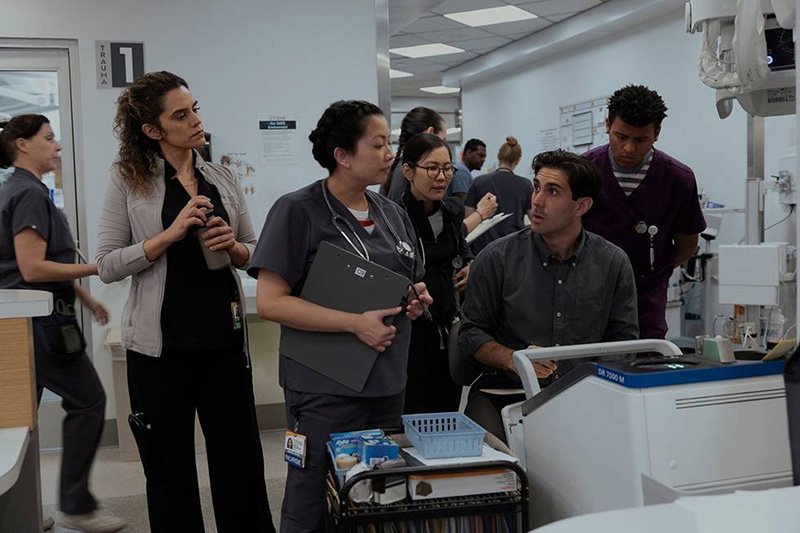
(L-R) Sepideh Moafi, Kristin Villanueva, Irene Choi, Adam Shaukat (Photo by Warrick Page/HBO Max)
Villanueva gives credit to Joe Sachs, MD, executive producer and writer, for bridging the chasm between the show and Filipino nurses. “He was an emergency doctor for many years and worked with a lot of Filipinos.” She acknowledges that the show’s writers do extensive research to ensure accuracy in all areas, including bits of Tagalog dialogue that are always pleasant surprises.
Real health care workers rave about the realism the show brings to the studio emergency room. Realism permeates every hour of the medical shift. Laypersons don’t appear to mind wincing for the duration of a femoral amputation because everyone values relatable storylines that mirror events affecting average people in their daily struggles.
“I feel that for as long as The Pitt airs, it will always be an instrument for societal change,” remarks Villanueva. “It is so good at showing the repercussions of whatever the government decides to do that month on the lives of everyday people.”
If social media posts are useful samplings, they suggest that Villanueva echoes the sentiments of most of the show’s 10 million viewers. The Pitt doesn’t preach against the pathologies the government inflicts on people, who are often vulnerable, innocent children. Instead, it illustrates the consequences of such policies in the high-stakes setting of a hospital.
For examples of topical relevance, in Season 1 the son of an anti-vaxxer is fighting for his life because he had no immunity during a measles outbreak. Dr. Robbie tries to reason with the parents. In the current Season 2, a proud father who lost his insurance forbids his daughter from crowdfunding to pay his six-figure hospital bill. A child loses three fingers in a firecracker accident. His teenaged sister fears that he will be placed in foster care once the hospital social worker learns that she has been the boy’s legal guardian during the nine months since DHS (Department of Homeland Security) deported their parents to Haiti.
Another Example of Warner Bros. Quality
If you were to binge-watch Charlie Chaplin movies, you would realize that house calls weren’t a luxury but the modus operandi for doctors to treat patients in the era before talkies. Even a sick hobo in a flophouse welcomed a visit from a man with a black medicine bag.
Within the great ensemble of The Pitt is the small yet trailblazing group of Filipina actors: Villanueva, Isa Briones (Dr. Trinity Santos), and Amielynn Abellera (Perlah Alawi).
Considering that most babies were born at home, hospitals must have been treating patients who were suffering illnesses more painful than childbirth. During the Keystone Cops era, patients probably arrived in ambulances that bore a resemblance to paddy wagons. In other words, early American hospitals were ancestors of modern trauma centers like the one depicted in The Pitt.
The show conveys that in some areas facing economic hardship, hospital care has gone full circle since the days of Warner Bros. brothers Harry, Albert, Sam, and Jack. HBO Max is a division of Warner Bros. We hope that Warner Bros. will continue to give us relevant, engaging entertainment. If The Pitt has become the conscience of America, the soul of the show is its Filipina characters: Princess, Perlah, and Dr. Santos.
The show is a refuge from the tensions in the world and pressures at home, but each episode provides just one hour of escapist drama. Filipinos are known for their resilience, spontaneous quips, and incandescent smiles. When Villanueva is having a bad day, she meditates to restore the joy. What is your release?

Anthony Maddela knows that sinking feeling of waiting for scan results on a gurney in the hallway of a crowded ED, when the PA system pages the attending physician that a call from Oncology is on hold. Nevertheless, he’s been blessed to be cancer-free for three years, thanks in great measure to UCLA medical staff.
More articles from Anthony Maddela



No comments