
Was Linda Ty-Casper Really a "Saling Pusa?"

Linda Ty-Casper (Photo courtesy of Mara Coson)
The saling-pusa term probably came about because of this:
Between 1953–1956, the noted academic and critic Leonard Ralph Casper taught at the Ateneo de Manila, the University of the Philippines, and Philippine Normal College. There he befriended Filipino literary giants, among them Francisco Arcellana, Amador Daguio, Alberto S. Florentino, Nick Joaquin, F. Sionil Jose, N.V.M. Gonzalez, and Bienvenido N. Santos. When Leonard returned to the U.S. (with Linda after they got married in 1956), he wrote books about Philippine writing, some of which were published in the U.S. and helped introduce Philippine literature to American readership.
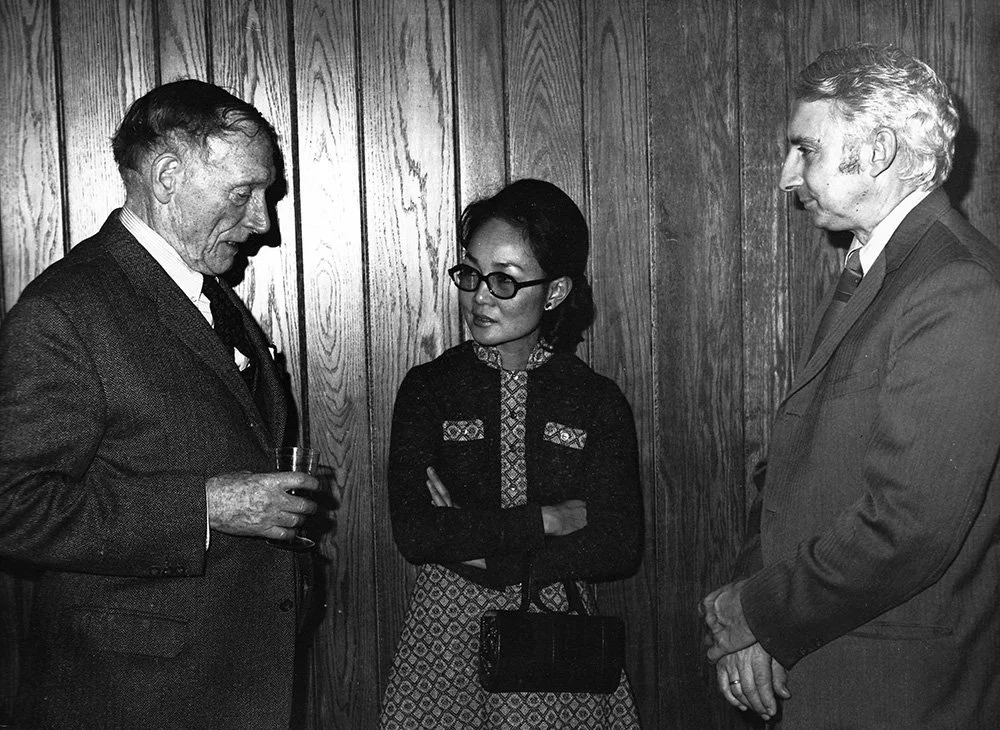
l-r: Robert Penn Warren, Linda Ty-Casper, Leonard Ralph Casper (Photo courtesy of Linda Ty-Casper)
Many of Leonard’s mostly male literary contacts taught in universities. Some were publishers, such as F. Sionil Jose and Alberto S. Florentino (Florentino’s Peso Books published Linda’s first book, The Transparent Sun and Other Stories, in 1963). They were also members of writers’ groups that helped enhance their literary standing (N.V.M. Gonzalez and Francisco Arcellana were members of the famous “Veronicans”).
Linda, on the other hand, was a member of PEN Women Wellesley (in Massachusetts), but she did not enjoy the extensive Philippine support systems that Filipino [male] writers had.
Linda was a housewife and mother to two girls in the U.S. Because her husband taught at Boston College and was busy with his academic and literary activities, I suspect Linda did the lion’s share of the housework and gardening; of raising the girls; and of driving them to and from school, CCD (for their religious education), and Fil-Am cultural activities. Further, Linda and Leonard were members of Birthright, Nuclear Freeze, Pro-Life, Prison Ministry, Movement for a Free Philippines, and anti-Marcos protest groups. In other words, Linda was very busy. Still, she wrote her stories and garnered awards (SEA Write Award, the ALIWW Parangal, UNESCO/P.E.N., Rockefeller [Bellagio], Radcliffe Fellowship), among others. With these recognitions and 20 book titles to her credit, Linda Ty-Casper is no saling-pusa.
Linda’s connection with writing goes back to her childhood. In her Lives Remembered, A Memoir (PALH 2025), she talks about some people and an event that influenced her.
First, there was her grandmother, Nanay, or Gabriela Paez Viardo, whose mother came from Malabon and whose red-headed father came from Portugal. Nanay used to tell stories about the revolution and the war with the Americans, and other historical anecdotes. Linda listened avidly, and she also paid attention to Nanay’s admonition, “Someone should write these stories”—words that would stick in Linda’s mind until the time was ripe for her to act on her grandmother’s wish.
Second, there was Linda’s mother, Catalina Velasquez Ty, who taught fourth grade and later worked at the Department of Education, Curriculum Division. She wrote textbooks for Macaraig Publishers and for Ginn & Company of Boston. She brought home numerous books for Linda and her sister to read. Linda’s poem “The Ant” was published by the Philippine Journal of Education, for which her mother also wrote. Linda was nine years old when she received a one-peso check for her poem.
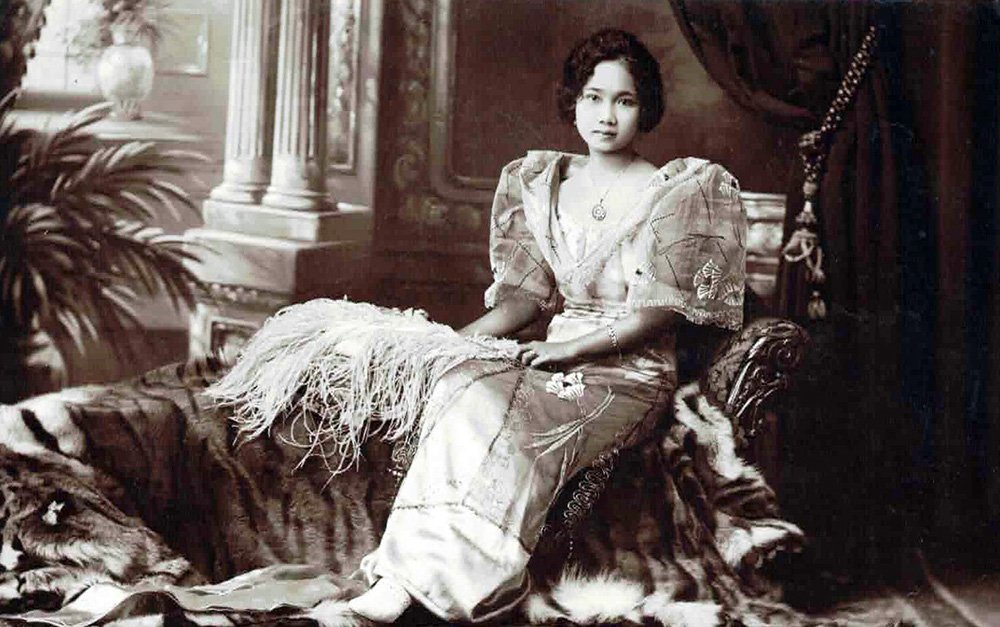
Antique photo of woman showing Catalina Velasquez Ty (Linda’s mother)
Third, there was the event that Linda relates as an important turning point in her life. She was at Harvard when an impending hurricane caused her law classes to be canceled. She went to Widener Library to find refuge. While looking at Philippine books and periodicals, she discovered inaccurate material about Philippine history. Linda decided to write a historical novel to correct these errors. She did not stop with one novel. Setting aside her career as a lawyer (she had an LL.M. in International Law from Harvard), she embraced this call to write. With her mission of correcting erroneous Philippine historical data, Linda wrote primarily historical fiction.
Her early novels were set during the Spanish and American occupations in the Philippines:
The Peninsulars (Manila: Bookmark, 1964);
The Three-Cornered Sun (Quezon City: New Day, 1979; Manila: Exploding Galaxies, 2024);
Ten Thousand Seeds (Manila: Ateneo de Manila University Press, 1987); and
The Stranded Whale (Quezon City: Giraffe Books, 2002).

Linda Ty-Casper holding book The Three-Cornered Sun (Photo courtesy of Linda Ty-Casper)
When Ferdinand Marcos declared martial law in the Philippines on September 23, 1972, and began his 14-year repressive and bloody dictatorship, Linda went on to write novels of justice, or protest novels, against the Marcos dictatorship. They are:
Dread Empire (Hong Kong: Heinemann Asia, 1980);
The Hazards of Distance (Quezon City: New Day, 1981);
Awaiting Trespass: A Pasion (London: Readers International, 1985);
Fortress in the Plaza (Quezon City: New Day, 1985);
Wings of Stone (Manila: Ateneo de Manila, 1986);
A Small Party in a Garden (A Pasion) (Quezon City, 1988); and
Dream Eden (Manila: Ateneo de Manila University Press, 1996).

A Small Party in a Garden: Revised and Critical Edition
It should be noted that Linda’s works of fiction were so powerful that two of her protest novels, Wings of Stone and Awaiting Trespass, were banned in the Philippines during the Marcos dictatorship.
Aside from these novels, Linda also published short story collections, her Lives Remembered, A Memoir (PALH 2025), and her husband’s biography, Will You Happen, Past the Silence, Through the Dark?: Remembering Leonard Ralph Casper (PALH 2022).
Her recent publication, released by PALH (Philippine American Literary House, which I run), is A Small Party in a Garden: Revised and Critical Edition. Referred to as a “novel of justice,” this edition reintroduces this important work of historical fiction to a new generation of readers. First published almost forty years ago, A Small Party in a Garden is set in the Philippines during the Ferdinand Marcos dictatorship. The story’s protagonist, a privileged woman who is the right-hand woman of Imelda Marcos, learns in a horrific way what brutality meant under Marcos’ martial law. This revised and critical edition includes an introduction by Dr. Charlie Samuya Veric (professor at the Ateneo de Manila University), an article by Dr. Lynn M. Grow (emeritus senior professor of English at Broward College), and some past book reviews of Ty-Casper’s novella.
In fact, Linda Ty-Casper has around 20 published books to her credit and is acknowledged as a prolific and important Filipino novelist.
It is ironic that despite Linda’s A Small Party in a Garden, written to protest the Marcos dictatorship, the Philippines installed another dictator, Rodrigo Duterte, who instigated his “drug war” with 20,000–30,000 victims. Further, the body of Ferdinand Marcos is now ensconced in the Libingan ng mga Bayani (Cemetery of Heroes), and his son is president. The Philippines is currently racked with graft and corruption cases—ghost projects, padded congressional budgets, massive flood control graft, political dynasties, among many other problems.
This is perhaps one reason why Linda Ty-Casper’s historical novels remain relevant and important: like a sage, and through her writings, Linda continues to inform readers about what happened in the Philippines and what can happen if we do not learn from history.
Those who cannot remember the past are condemned to repeat it ~ George Santayana.

Cecilia Manguerra Brainard (ceciliabrainard.com) is the author and editor of over 22 books, including the novels When the Rainbow Goddess Wept, Magdalena, and The Newspaper Widow, and her Selected Short Stories. Her writings have been translated into Arabic, Greek, Japanese, Portuguese, Slovenian, Macedonian, Azerbaijani, and Serbian. She also has earlier translations in Turkish and Finnish. She has received an Outstanding Individual Award from her birth city of Cebu, a California Arts Council Fellowship, a National Book Award, the Cirilo Bautista Prize, travel grants from the U.S. Embassy and from the National Book Development Board, among others. She runs a small press, PALH, or Philippine American Literary House.
More articles from Cecilia Manguerra Brainard



No comments