
Where Talk of the Town Got Done in Paete, Laguna

The original site of Tayangtang (bench) ni Karyong Bado in Paete, Laguna where participants met regularly, offering one another’s take from village gossip to world affairs.
Tayangtang served the town’s then-graying male population—folks who, despite faltering minds and failing vision, were still able to summon their inner youth as a group and reminisce about events of 70 or 80 years ago.
Ramon Cajipe Angeles, a retired elementary school master-teacher, described how motley gatherings of older folks and not-so-old men enjoyed lasting camaraderie as they shared stories, mostly of the past, in Tayangtang settings.
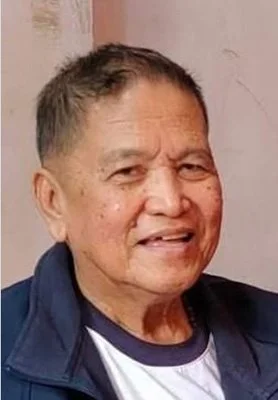
Retired Master Teacher Ramon Cajipe Angeles says World War II stories are favorite topics in Paete Tayangtang gatherings. He said Japanese forces occupied and burned the town during the war and drove the residents to take shelter in the Sierra Madre mountain for many months.
Angeles said the men doted on narratives that had been told and retold many times over but continued to engage those huddled together for hours, usually well into the night. “They mostly talked about the war,” Angeles said, “and at each retelling, new perspectives emerged.” The stories plumbed the depths of emotion, recalling the trauma and devastation when the town was burned to the ground by fleeing Japanese forces toward the end of the Second World War, Angeles related.
Tayangtang was vintage Paete, a small Laguna town south of Manila. This was the town’s indigenous term for a bench, serving as a nerve center for things precious and dear to its residents. Paete folks claim that the term is unique to the town, even if recent Tagalog dictionaries refer to “tayangtang” as “sun-dried”—something placed under the sun to dry and, intentionally or not, left seared. One might search for any ounce of similarity between the two terms, except perhaps the fact that participants in Paete’s Tayangtang remained for long hours, huddled and sparking, stretching each tale they shared with raging passion.
There had been similar wooden benches through the years, but there could only be one Tayangtang “ni Karyong Bado.” Situated a few meters away from the Ermita Church along the old highway, the Tayangtang bench occupied a special spot beside the store owned by Macario Valdellon, once a member of the Paete Municipal Government. Valdellon’s name rose in value not so much because of his success as an entrepreneur, but perhaps more because of the historical bond that tied his name to the past and the people of Paete.
Tayangtang ni Karyong Bado, the wooden bench, and the Paeteño had been through life’s many seasons together. It served as a forum where the town’s self-proclaimed geniuses, philosophers, and gossips dropped in to discuss the latest developments on the local, national, and international scenes. A favorite topic had been war—the Battle of Paete during the US-Philippines Revolution, as well as World War II, with the ferocious burning of the town by Japanese forces.
Tayangtang was also where one first heard who had just arrived in town; who had recently died, given birth, found a new job or lost one; who had gotten married; or who was sleeping with whom—small talk that might have sounded mundane. Yet these were the tales that threaded the lives of a people. They found comfort in these homespun accounts and passed them on to friends and relatives dispersed in the town and elsewhere.
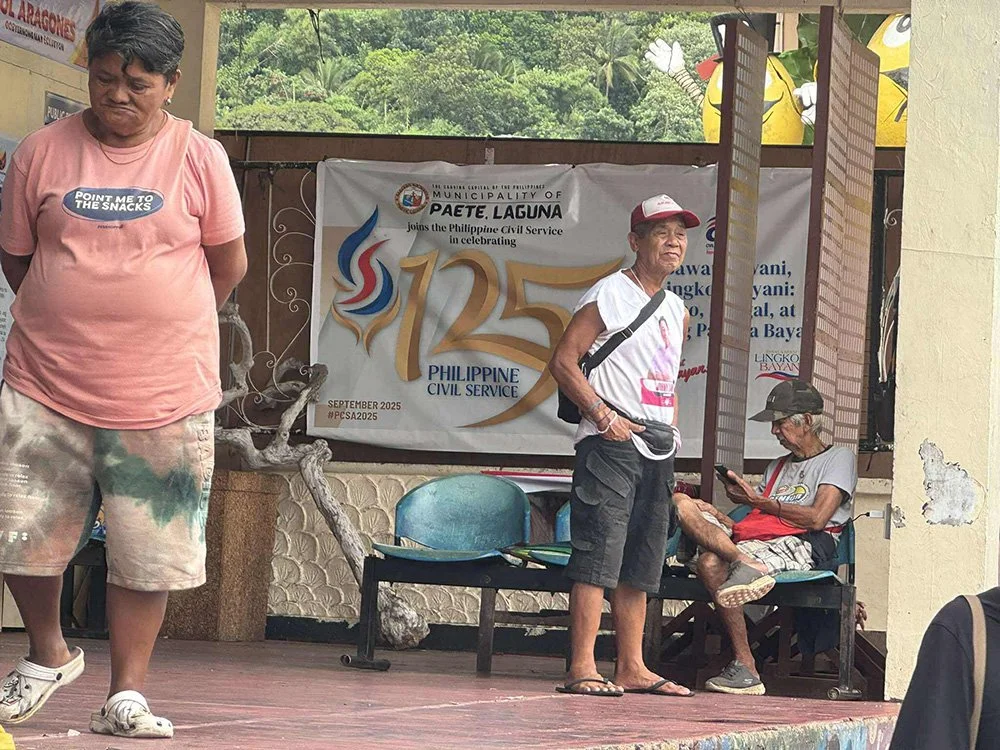
A couple of fellows linger by one of Tayangtang benches in town, waiting for other participants to join their regular huddle.
The first Tayangtang bench served as a sort of pre-departure lounge where townsfolk sat waiting for rides to take them out of Paete. Owing to its strategic location, Tayangtang invariably became the principal source of the latest news from Manila and areas outside Paete, brought in fresh by early-morning arrivals. It proved to be a convenient place for embarking and disembarking passengers, eventually evolving into a public forum where people—not necessarily travelers—met to trade stories. This was where, according to local historian Virgil Madrinan, standards for non-Paetenian brides brought home by local boys were defined:
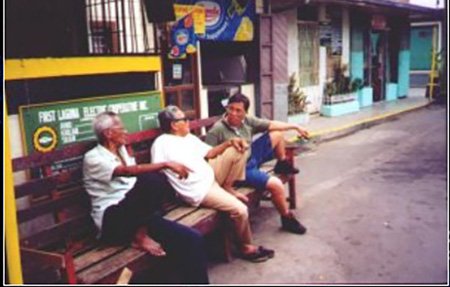
Paete menfolk enjoy lifelong friendships during hours seated at a Tayangtang bench sharing stories about life in this small town in Laguna.
(a) yung mga puwedeng iuwi ng tanghaling tapat (those who could be showcased at noon), and
(b) yung iuuwi lamang ng “first trip” or “last trip” (those who needed to be hidden from public view, brought to town only on the first or last trips).
Tayangtang remained a congenial spot for male bonding, not only for discussions on the meaning of life—or the lack of it. It was also perfect for the uniquely Paete “usloan,” a locally coined term referring to occasional digs at things personal and irreverent, led by the town’s most rowdy, raucous types—the buharo and the rascals.
Tayangtang still holds court in quaint corners of this little town nestled at the foot of the Sierra Madre mountains. The location of the original Tayangtang on the main road is now a designated public safety enforcement stand overseeing frequent arrivals and departures of vehicles northbound for Santa Cruz, the provincial capital, and those taking the eastern route to Metro Manila via neighboring Rizal province.
Current Tayangtang locations are now places where men usually congregate on Sundays and during church celebrations. The concrete sidebars of the stage in the town plaza are perfect examples. These structures were fashioned into twin stone benches on both sides of the two bridges connecting the plaza to the Catholic church and its expansive patio (courtyard).
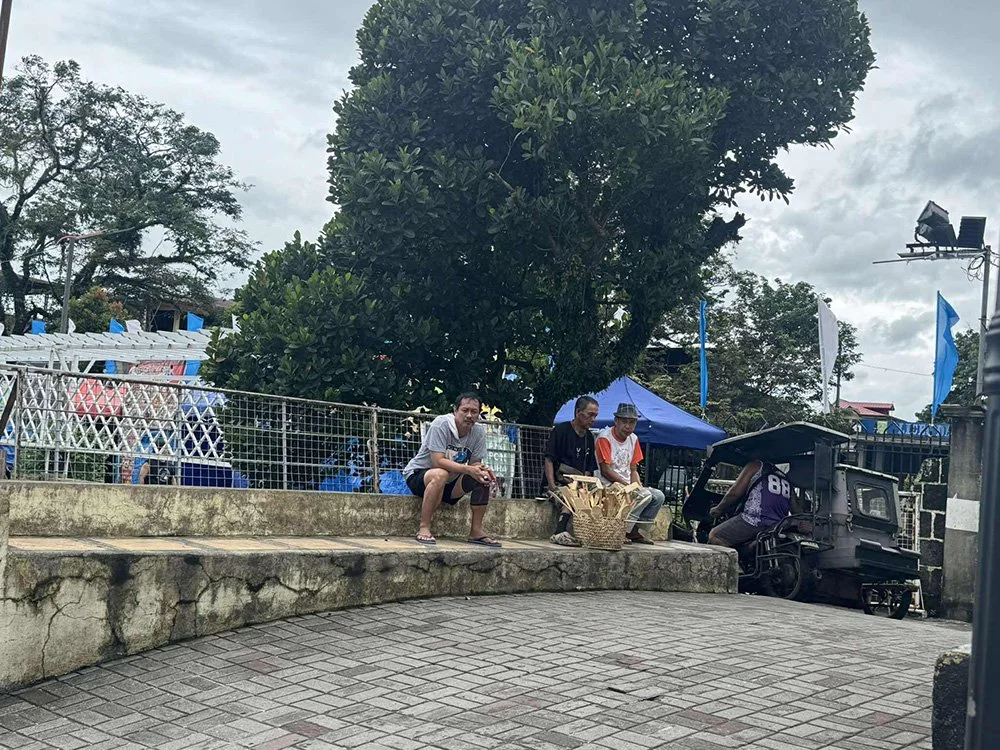
The bridge’s concrete guardrail by the townsquare makes for a comfortable tayangtang bench where folks gather for a weekend chat following church services on Sundays.
The five adult men seated together on that concrete bench were deep in conversation on Easter Sunday morning this year, oblivious to the stream of townspeople traversing the bridge after church services. Asked whether the group could be considered a makeshift Tayangtang, the men exchanged awkward glances, unsure how to respond. “Meron po yatang tayangtang, kina Amang Dando,” one finally said (“There might be one at Amang Dando’s”), “sa ibaba (down),” still wondering about the sudden interest in what seemed an icon of the past. “Do they still meet regularly to reminisce about the old days?” came the follow-up question. Again, bewildered, inquiring half-smiles. Two of the men were not sure. A third reckoned that perhaps people now just text one another. “Matagal na pong wala yung Karyong Bado (Karyong Bado is long gone),” was the final answer.
Paete people are yet to get used to citing the street names of their small municipality. “Ibaba” means “down,” a walk toward the lake; the opposite, “ilaya,” refers to the upper part of town, midway toward the mountain. When one is up in the mountains and considers going back to town, folks say “lulusong.” To return to the mountain, one says “aahon.” The strategic play on directions—upward and downward, and moving through water versus climbing back—reflects the presence of the majestic Sierra Madre on the northwest side and Laguna de Bay, considered the third largest lake in Southeast Asia, on the east.
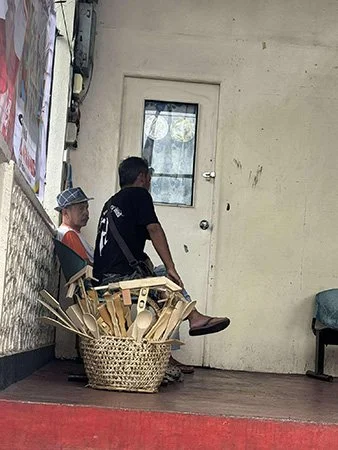
Menfolk grab a moment to talk at the end of the day. In the foreground is an assortment of tools and accoutrements of wood crafting used by the town’s renowned woodcarvers and artists.
The women of Paete stayed clear of the Tayangtang, effectively designating it as a forum for men to enjoy exclusively male talk. It was a comfortable setting for rambunctious exchanges of “conquests” and pleasures, real or imagined. One sat at Tayangtang without knowing what topics would arise. A newcomer could immediately engage or simply lurk and listen. A townmate passing by was almost always hailed into joining the fray, with the customary inquiry, “Saan baga ang punta mo?” (And where might you be going?)—which, to a non-Paeteño, might feel like an intrusion into privacy. But it was Paete’s way of breaking the ice. The manner in which the question was conveyed, along with the characteristic Paete punto or accent, half-pleaded for a response. It was good manners for the one invited to pause briefly for the obligatory kumustahan (how-are-yous) after deftly sidestepping questions about his destination. It also provided a polite exit for others who needed to move on.
A version of Tayangtang ni Karyong Bado surfaced in cyberspace in early 1997, organized on the town’s first website, paete.org. The founder, Rey Q. Carolino, and his Canada-based kababayans created a Paete chatroom on the DALNET Internet Relay Chat (IRC) network. They invited members of the Paete mailing list, and the first such chat was launched in real time. Early participants came from North America, Asia and the Pacific Islands, and Europe. The group held a Paetenians Internet Seminar in 1997 in Toronto, and the live internet chat brought in more kababayan (compatriots) from other parts of the globe.
It was Pastor Gagaring, a staunch Tayangtang devotee from Saipan, who recommended naming the forum “Tayangtang ni Karyong Bado.” Thus, the Tayangtang bench went high-tech. The participants were now male and female, of various age groups and from diverse backgrounds. The language used was a mix of English and Tagalog—but decidedly usap-Paete in character and appeal.
Back at the home of Ramon Angeles, the former grade school master-teacher was hosting his friends: a retired dentist, a couple of village politicians, and a former co-teacher. Over a large plate of fried cassava chunks and peanuts, they engaged in spirited discussion with much gesticulation and a chorus of overlapping voices. Laughter occasionally punctuated the rowdy banter. They were clearly decades older than the men by the church bridge.
“This now is a Tayangtang!” Angeles declared, nodding vigorously. “Not ‘the,’ but ‘a tayangtang,’” he explained. True enough, the group had the makings of one: no longer in a storefront like Karyong Bado’s, but still a gathering of men absorbed in conversations that felt urgent and all-consuming. And yes, each of the men also had a cellphone nearby.
A version of Tayangtang ni Karyong Bado surfaced in cyberspace in early 1997, organized on the town’s first website, paete.org.
Tayangtang very often erupted into a wild usloan when old hands at this kind of roasting took over. There would be moments of purely Paetenian mirth, and everyone would soon forget how the banter sometimes bordered on the profane or the sacrilegious. Goodbyes were always temporary (“See you next week in TKB”).
It has been many years since the Tayangtang bench in Paete hosted its last forum with the menfolk. The internet chatroom on the town website—and the website itself—has long been shuttered. Paetenians from all over now live out their lives in public orbits through platforms like Facebook, Messenger, Zoom, or Teams. Yet each text message, voice or video call, multimedia post, image upload, and kababayan conference still echoes the sentiments of a people longing for images and memories of the charming little town they left behind.
Connie Cagahastian Triggiano keeps the minutes for Circa‑Pintig, the community theater of Pinoys across Chicagoland, but she lives expansively. She threads tales, follows far‑off skies, breaks open word grids, and reads the world one book at a time.
More from Connie Cagahastian Triggiano



No comments