
Hard Hats: Filipino Civil Engineers in the Middle East
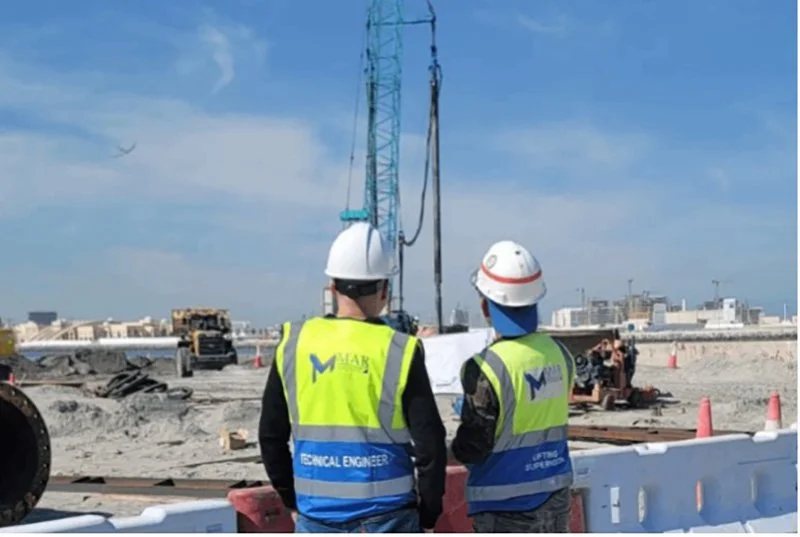
Engr. Michael Lucero and Lifting Supervisor Neil Braga overseeing vibro compaction works in critical areas, part of a Value Engineering strategy combining dynamic and vibro compaction methods to optimize performance, safety, and cost.
Why the Middle East?
For many Filipino civil engineers, the Middle East was never the original dream—it became the destination because it was possible. “Originally, my dream country to live and work in was Australia because I have relatives there and quality of life is good. I decided to work in the Middle East because the application process is straightforward, deployment is quick and the earning potential is higher.” — Christopher Fermo, Senior QS Engineer. While opportunities in Western countries often came with long credentialing processes, licensing barriers, and years of local experience, the Middle East offered something more immediate: access. Applications moved faster, interviews were practical rather than bureaucratic, and skills mattered more than polished resumes.
The region’s relentless pace of development created openings that few other places could match. Roads, airports, railways, towers, and entire cities rose from the desert, demanding engineers in numbers rarely seen elsewhere. For Filipino professionals—known for adaptability and hands-on competence—this meant steady demand across infrastructure, commercial, and industrial projects. “I decided to work in the Middle East because my salary in the Philippines wasn’t enough to meet my family’s monthly needs and prepare for my children’s future. Working abroad allows me to provide better financial stability and secure my family’s future.” — Ross Fernandez, Site Engineer.
Experience, while important, was not always a gatekeeper. Many companies learned early on that Filipino engineers grew quickly on the job. Those who arrived with limited experience were often given responsibilities that accelerated their learning, guided by senior Filipinos who had already earned the trust of employers. Over time, this created a quiet pipeline: one generation opening doors for the next.
What began as opportunity gradually became reputation. “What surprised me most about working in the Middle East was how diverse the workplace is and how people from different cultures work together professionally and respectfully.” — Christopher Fermo, Senior QS Engineer. Filipino civil engineers were seen as dependable, collaborative, and willing to learn—traits valued in multinational project teams working under tight deadlines. In an industry where performance spoke louder than pedigree, the Middle East became not just a place to work, but a place where careers could take shape.
The Filipino Engineer at Work
On site, the Filipino engineer often operates at the intersection of planning and reality—translating drawings into action while navigating constraints that shift by the hour. “A typical day on site starts with reviewing the work schedule and priorities for the day, followed by a toolbox meeting with the team to discuss safety and planned activities. Inspect ongoing works to ensure they follow the approved drawings, specifications, and quality standards. I coordinate with subcontractors, supervisors, and suppliers to resolve technical issues, monitor progress, and make sure targets are met. I also prepare site reports, update documentation.” — Ross Fernandez, Site Engineer.
Whether coordinating with foremen, responding to unexpected site conditions, or balancing safety, cost, and schedule, their role is rarely confined to a single job description. It is in this daily negotiation between design and execution that many Filipino engineers quietly prove their value—steady, solutions-oriented, and dependable under pressure. “To succeed as a QS Engineer in large-scale infrastructure projects, it takes strong technical knowledge, attention to detail, and a solid understanding of contracts, cost control, and project documentation. It is also important to have good communication and coordination skills, as these projects involve multiple stakeholders, tight schedules, and diverse teams. Adaptability, integrity, and the ability to work under pressure are key to delivering accurate cost management and supporting project success.” — Christopher Fermo, Senior QS Engineer.
Beyond the Hard Hat
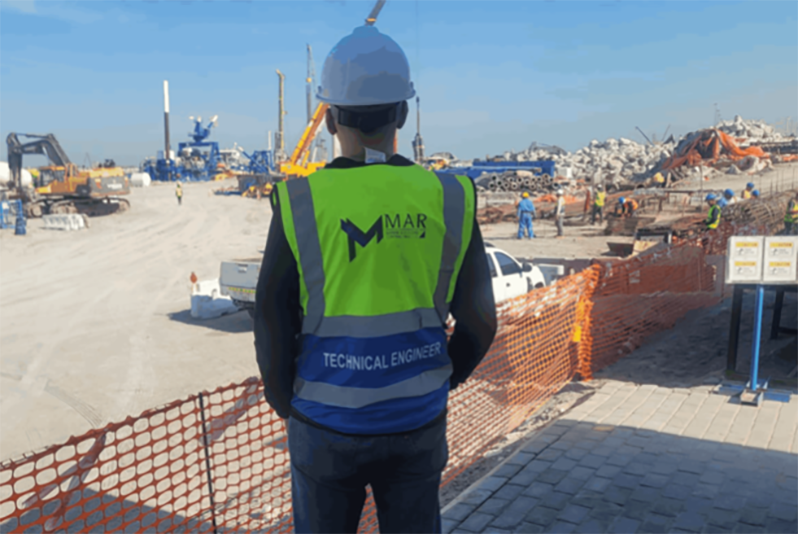
Engr. Michael Lucero observes the actual piling operations for cost adjustments.
Work in the Middle East is demanding, but it is often the hours after work that test Filipino engineers the most. When the site quiets down and the helmet is set aside, many return not to family or familiar voices, but to a small room far from home. It is in that silence—after long days of calculations, coordination, and decision-making—that loneliness tends to surface.
For some, it arrives as a question quietly asked at night: Was this the right decision? Especially for those who had careers back home, the distance can feel heavier when weighed against what was left behind. Professional progress comes at the cost of presence—of being there when life happens. “One of the hardest challenges I faced was managing homesickness and boredom while adjusting to the cultural differences of the host country during my early years in the Middle East. This experience pushed me to grow personally and professionally. During my toughest years abroad, what kept me going was my determination to grow stronger both personally and professionally. Being far from home pushed me to become more resilient, disciplined, and self-reliant. Professionally, the challenges motivated me to improve my skills, stay competitive, and prove my value in a demanding work environment. Personally, my family, my goals, and my belief in hard work gave me the strength to keep moving forward.” — Christopher Fermo, Senior QS Engineer.
Yet for many OFWs, that same distance becomes a space for reflection and faith. Far from familiar routines and comfort zones, engineers find time they never had before—time to listen, to reflect, and to reconnect with God. Invitations to attend worship services or small Bible studies, often from fellow Filipinos, become lifelines. What begins as companionship grows into fellowship, offering not just comfort, but meaning. In shared prayers and quiet conversations, loneliness is eased, and faith deepened.
There are other moments of comfort, quieter but equally powerful. Salary day brings relief and purpose—the chance to send support back home, to help families meet daily needs and slowly build shared dreams. Each remittance is more than money; it is reassurance, responsibility, and love expressed across distance.
Still, sacrifice remains the constant undercurrent. Parents worry daily about their children abroad—if they are safe, healthy, and eating well. Spouses left behind carry the weight of raising children alone, shaping values, managing households, and holding families together while partners work thousands of miles away. Love endures, but it is tested by absence.
What cuts deepest are the moments missed: birthdays celebrated through screens, graduations watched in pixels, Christmases spent on video calls instead of around the table, New Year’s counted down in a different time zone, anniversaries marked by messages instead of embraces. Technology makes connection possible, but it cannot replace presence. There is a quiet ache—difficult to explain, impossible to ignore—that comes from knowing you are providing for your family while being physically absent from their lives.
For some, that absence eventually leads to a different kind of adjustment—coming home. Former OFW engineer Francis A. Saltivan describes reintegration as “a mix of both.” Professionally, he adjusted quickly because the technical skills gained abroad remained useful. Personally, adapting to a slower pace and different work culture took time—but being closer to family and applying his experience back home made the transition worthwhile.
“What is rarely talked about is the personal sacrifice of being away from family and missing important moments. These challenges teach resilience, discipline, and responsibility, and motivate me to work harder to provide a better future for my family while representing Filipino engineers with pride.” — Ross Fernandez, Site Engineer.
This is the part of the engineer’s life that does not appear on resumes or project reports. Beyond the hard hat, Filipino civil engineers carry longing alongside responsibility, faith alongside doubt, and love measured not by proximity, but by sacrifice.
Identity and Respect
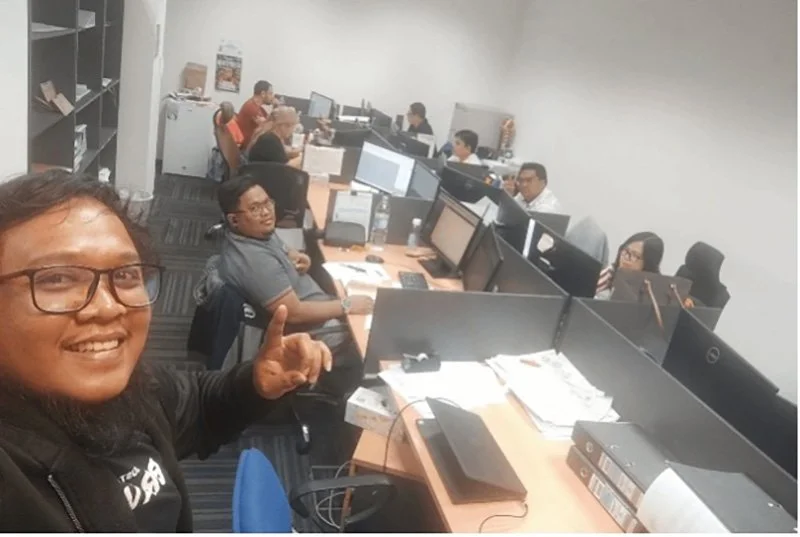
Engr. Von Villar with fellow QS Engineers during a workday at the office.
In multinational construction sites across the Middle East, trust is rarely given outright—it is earned, often quietly, over time. For Filipino civil engineers, credibility is built not through titles or bravado, but through consistency. Many arrive knowing that they do not have all the answers, and instead of hiding gaps in experience, they ask questions. They watch, learn, and request examples. What they lack in familiarity, they make up for with humility and effort.
Attention to detail is one of the traits colleagues quickly notice. Drawings are checked carefully, instructions followed precisely, and responsibilities carried through to completion. Filipino engineers are often willing to take on additional work, cover for absent teammates, or step into unfamiliar tasks without complaint. In environments where teams are composed of many nationalities and communication is imperfect, this adaptability matters. Being able to understand colleagues who struggle with language—and meet them halfway—becomes an unspoken strength. “Filipino engineers usually excel on site in adaptability, teamwork, and work ethic. We are known for being hardworking, reliable, and willing to take on responsibility even in challenging conditions.” — Ross Fernandez, Site Engineer.
Over time, this reliability shapes reputation. Filipino engineers are known as professionals who do what is good for the project and the company, even when no one is watching. Trust grows not from single moments, but from repeated proof: deadlines met, problems solved, and work delivered with care.
Yet respect is not always immediate. At the start of many careers, Filipino engineers face subtle stereotyping. They may be viewed primarily as technical support rather than decision-makers—valued as “good workers,” but not always seen as leaders. Promotions, when they come, are sometimes quiet; responsibilities increase faster than recognition. Authority is earned gradually, often long before it is formally acknowledged.
Sheila Ann Paragas-Noveloso, a QS Engineer with fifteen years of experience in Qatar, shared that earlier in her career, clients sometimes preferred dealing with male colleagues during meetings. Over time, however, consistent preparation, professionalism, and confidence helped shift those perceptions—reflecting a gradual move toward merit-based recognition in the workplace.
Most Filipino engineers accept this reality without protest, choosing patience over confrontation. Respect, they know, comes with time and performance. In an industry where results matter more than words, many learn to lead through action—earning influence before titles, and recognition through outcomes rather than applause.
“I earned respect by consistently delivering quality work and demonstrating reliability and professionalism. As I gained experience, I became more confident in my work and professional judgment, which allowed me to communicate more clearly and assert myself when needed.” — Sheila Ann Paragas-Noveloso, QS Engineer.
This balance—between capability and perception, between contribution and visibility—becomes part of the Filipino engineer’s professional identity in the Middle East. It is not an easy path, but it is one navigated with resilience, integrity, and the quiet confidence that respect, once earned, lasts.
Looking Forward
For young Filipino engineers considering the Middle East, it is important to understand that technical competence alone is not always enough. Skill opens doors, but how you carry yourself determines how far you go. Learn to communicate with clarity. Document your work. Protect your professionalism. Respect local cultures and workplace hierarchies, but never shrink yourself to fit unfair expectations. Confidence, consistency, and integrity dismantle prejudice more effectively than confrontation ever could.
“Despite having almost ten years of experience in the Philippines, I realized that when you work abroad, you often start from zero again. You have to learn new standards, adapt quickly, and prove yourself all over—but that process shapes you.” — Von Villar, Civil Engineer one-year OFW.
The landscape, however, is changing. More Filipino engineers are moving into supervisory and leadership roles, earning trust through performance and reshaping perceptions one project at a time. Each successful project, each promotion earned through merit, weakens outdated stereotypes and opens doors for those who follow. Progress may be slow, but it is real—and it is cumulative.
“My first ‘I belong here’ moment came when I realized I could adapt to a new environment, work with people from different nationalities, and handle responsibilities that once felt overwhelming. That’s when confidence slowly replaced doubt.” — Von Villar, Civil Engineer, one-year OFW.
What today’s engineers endure and overcome becomes tomorrow’s standard. By mentoring younger colleagues, sharing hard-earned lessons, and refusing to normalize subtle discrimination, Filipino engineers build a legacy that goes beyond individual success. The true impact lies not in titles or recognition, but in making the path clearer and fairer for the next generation.
In the Middle East, Filipino engineers are not just building roads, towers, and industrial plants. They are building credibility, representation, and quiet resistance against bias. Every carefully checked drawing, every solved site problem, every calm decision under pressure adds another brick to that unseen structure.
Sari’s feature films, documentaries, hybrids, experimental works, and video art are being screened in a multisite retrospective which started in March and continues until May.
Even now, working here, I feel the distance from home, the discomfort, and the loneliness all too well. Yet, if I were starting out again, I would still choose this path. The hardship is hardest at the beginning, but with time, it strengthens you. Loneliness can be managed, even conquered, and families are only a video call away, present in daily life despite the miles. Life outside work also finds its rhythm. Cities offer communities—sports groups, faith fellowships, shared hobbies, and familiar places that bring comfort. From badminton courts and basketball leagues to chess clubs, camping trips, and weekend meals at Filipino restaurants, small routines restore a sense of home. For those assigned near urban centers, even bringing family to live in the Middle East becomes possible, turning a temporary posting into a shared chapter of life. And none of this stands alone. Today’s opportunities were shaped by those who came before—the skilled workers, foremen, and engineers of the 1970s and 1980s who laid the foundation of trust Filipino professionals now build upon. Their discipline and workmanship continue to echo across job sites, shaping how Filipino engineers are seen and valued. Long after the concrete has cured and the steel has weathered, what remains is not just infrastructure, but the mark left by engineers who stood firm, worked honestly, and proved their worth without asking permission. Acknowledgments Engr. Christopher Fermo, Senior QS Engineer, with 17 years of experience in the Middle East, who has handled mega-projects in roads and infrastructure. Engr. Ross Fernandez, Site Engineer, whose experience reflects daily site pressures and coordination with multinational teams. Engr. Sheila Ann Paragas-Noveloso, QS Engineer, providing insight on gender dynamics in Middle East construction companies. Engr. Francis A. Saltivan, Former OFW Engineer who returned to the Philippines, offering perspective on skills transfer and reintegration. Engr. Von Villar, Civil Engineer with one year of experience as an OFW, sharing experiences of culture shock and expectations versus reality. Their decades of professional experience, reflections, and personal stories provided invaluable perspective on credibility, leadership, and the long-term evolution of trust earned by Filipino engineers in the region. Michael G. Lucero is a Filipino civil engineer from Palawan who has been working as an OFW in the Middle East since 2006 and is currently based in Dubai, UAE. He writes narrative stories and blogs on Filipino life abroad, craftsmanship, and the quiet intersections of engineering, music, and everyday survival far from home, including guitar-related writing at jmjguitars.com. More from Michael G. Lucero



No comments