
Sampaguita on Center Court: What Alex Eala Means to Filipinos
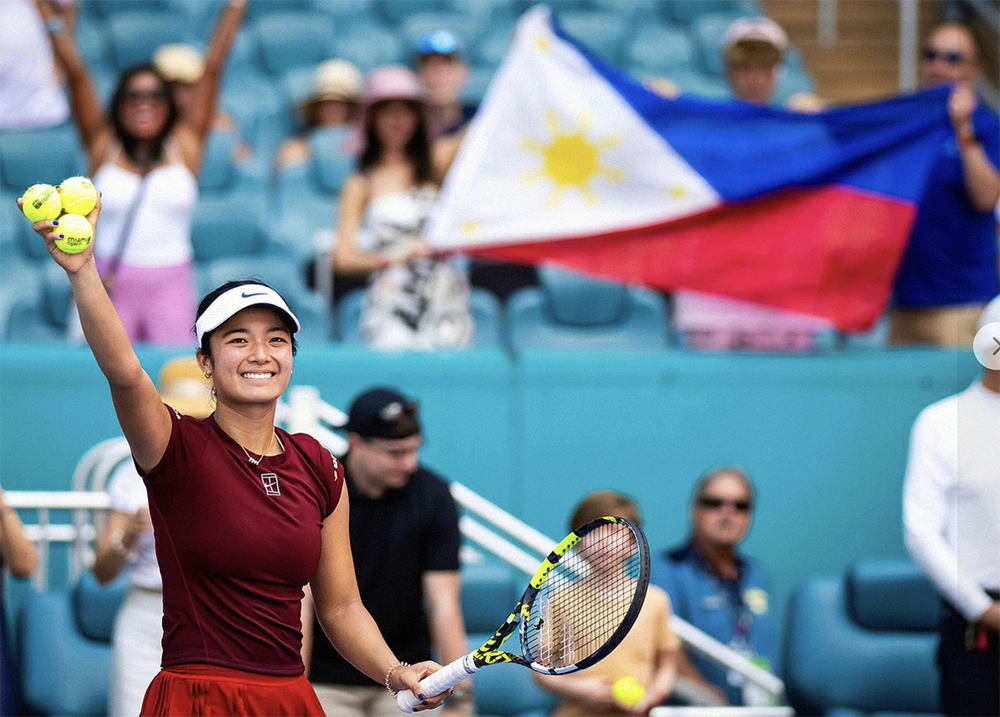
Alex eala breaking through at the Miami Open in 2025 (Source: Alex Eala’s facebook)
It belonged to gated clubs and inherited memberships, to spaces that suggested refinement rather than participation. Basketball courts appeared wherever there was open concrete; tennis courts, by contrast, felt set apart enclosed both physically, and socially. To watch tennis was to observe a world at some distance, not one in which most Filipinos could easily imagine themselves.
And yet, in the past year, with rapidly growing momentum, Filipinos at home and across the diaspora have been watching a young woman with rapt attention compete on the world’s most elite tennis stages with an unexpected sense of recognition. Alex Eala plays a sport long associated with privilege and Western pedigree, yet she does so carrying something unmistakably Filipino. Not loudly, not symbolically, but in a way that feels natural rather than asserted.
This may be why her rise has resonated far beyond the arena of sport.
An Elite Arena, Reconsidered
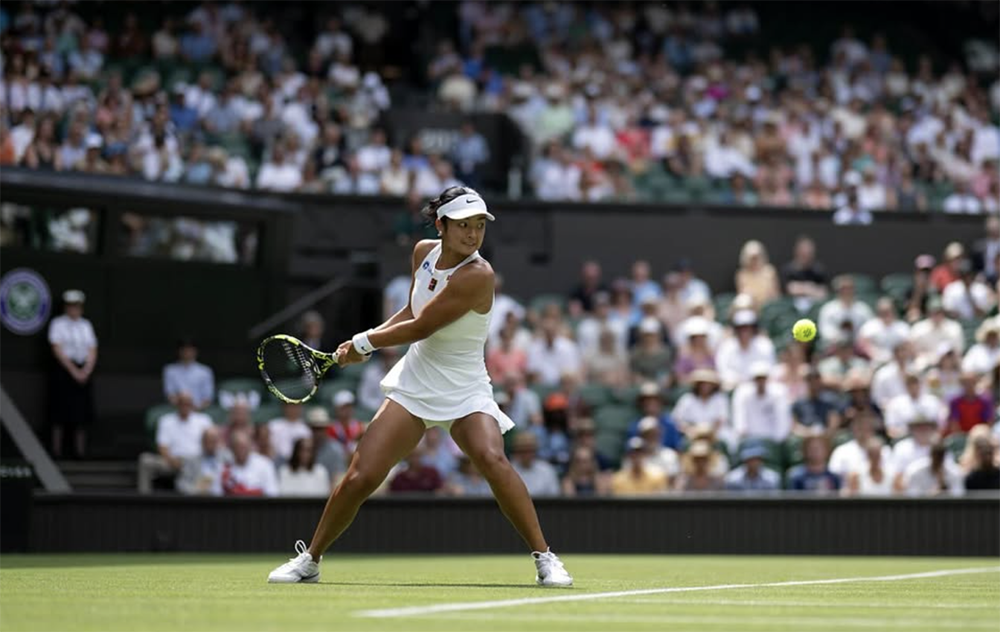
Eala at Wimbledon last year (Source: Alex Eala’s Instagram)
Alex Eala’s significance does not rest primarily on titles or rankings although her career-high WTA ranking of No. 29 as of March 16, 2026, is the highest ever attained by a Filipino tennis player. It lies instead in the cultural tension she quietly introduces. Tennis, long perceived as remote from everyday Filipino life, suddenly feels less sealed off. It remains inaccessible in the literal sense with expensive training costs and limited available courts — but it has become accessible in imagination and aspiration.
That recalibration matters. Nations are not built only through institutions or infrastructure; they are built through imagination. Through the slow accumulation of moments when people see themselves perform and triumph in places they were once told explicitly or implicitly were not appropriate for them.
Representation alters the relationship of what we view as what is achievable. When excellence appears culturally proximate, interest follows. What once felt alien or foreign begins to feel legitimate with a sense of immediacy.
Alex Eala does not make tennis a mass sport overnight. What she does is more subtle: she makes it imaginable. And imagination is powerful especially in societies shaped by inequality where aspiration is constrained.
Cynical observers may point out that she comes from an affluent background that allowed her to train in Spain. That is factually true. Yet she herself does not perform elitism. More importantly, her trajectory opens a broader conversation: not about whether her path was privileged, but about how future pathways might be widened so that access like she had is not the exception.

Eala at the Rafa Nadal Academy (Source: Alex Eala’s Facebook)
Carrying Culture Without Display
What further distinguishes Alex Eala is how she inhabits the global stage. She does not dissolve into a generic international athlete, nor does she perform identity in a self-conscious way. Her choices of speaking Filipino with ease and humility, acknowledging home, carrying cultural symbols such as the sampaguita feel unforced.
What resonates deeply with Filipino audiences is not humility alone, but humility paired with confidence that is an ease that neither shrinks nor boasts, and that refuses the false choice between deference and self-belief.
The sampaguita matters precisely because it is unremarkable. A national flower worn in spaces historically coded as European and elite does not announce itself as resistance. It simply exists. In doing so, it suggests that Filipino identity does not require translation to be legitimate.
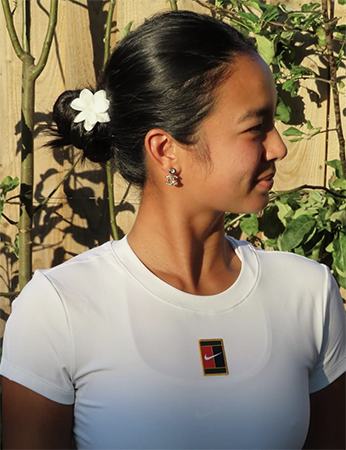
Eala with the Nike sampaguita hair tie (Source: Alex Eala’s Instagram)
For a diaspora long accustomed to adjusting itself to be understood, this carries significance.
Recognition and the Postcolonial Inheritance
Part of Alex Eala’s resonance, delicately but unmistakably, has to do with recognition.
She is tall by Filipino standards, her body well-suited to the demands of elite tennis. Yet her features, complexion, and manner remain unmistakably Filipina. This matters because colonial history shaped not only Philippine institutions but Philippine aesthetics. For generations, lighter skin and European features were privileged and subtly associated with legitimacy and access, especially in elite spaces.
These colonial hierarchies lingered long after formal independence, embedded in advertising, media, beauty pageants, and aspiration.
Alex Eala disrupts this historical inheritance without argument. She does not position herself against colonial ideals; she renders them beside the point. Her presence in elite global space normalizes a form of Filipino excellence that does not pass through older filters of validation.
For many Filipinos, she is the first tennis player who feels recognizable. Not aspirational in the glossy, distant sense, but legible and comfortably familiar. Her success invites a recalibration of who belongs in global elite spaces and who does not need to ask permission to enter them.
This quiet normalization may be one of her most lasting contributions.
From Gated Sport to Shared Attention
It is striking how widely Alex Eala has been embraced. Tennis has rarely occupied the center of Filipino sporting culture, yet her matches now draw attention from people who may never pick up a racket themselves or previously watched tennis at all.

Eala caught the world’s attention with her terno at the Laureus World Sport Awards in Madrid, Spain (Source: Alex Eala’s Instagram)
This is not because tennis has suddenly become democratic, but because identification has shifted. Alex Eala’s visibility invites ordinary Filipinos into a space that once felt closed not as participants, but as stakeholders in possibility.
I am aware of this distance myself. During my graduate studies in Japan, I had access to university tennis courts and could play regularly with Japanese and international students as one exhilarating way to unwind from our studies. It was an opportunity made possible by institutional privilege rather than economic and social class. It was an exception, not a pathway. For most Filipinos, such access remains unimaginable.
In this sense, her story mirrors broader questions of class and mobility. Who is allowed to aspire expansively? Who is permitted to imagine themselves on global stages? And who decides when ambition becomes excessive?
Promise, Not Arrival
What makes this moment especially revealing is that all of this is unfolding before Alex Eala has won a major title. At twenty years old, she represents not culmination but a generational promise. As I posted on social media, because she is still way below the performance of the topmost elite players of the game some foreign observers subsequently do not quite understand the Alex Eala phenomenon. Her appeal to Filipinos transcends tennis.

Eala wears a pink kit at the 2026 French Open at ROland Garros (Source: Alex Eala’s Instagram)
The Filipino nation is hungry for achievers who can make it proud; it is hungry for heroes.
She has captured the imagination of Filipinos as an underdog who, through grit and dogged determination, battles against the odds—not always successfully, to be sure, but with a never-say-die attitude that inspires. For tennis enthusiasts, including recent converts, her tenacity in staging remarkable comebacks is indelibly memorable: in the first round of the 2025 U.S. Open, and again in the second round of the recently concluded Indian Wells. This is resilience not as slogan, but as practice.
Filipinos are not responding to conquest in the form of prestigious titles; they are responding to possibility. There is a shared intuition—felt more than articulated that something larger may be forming, that we are witnessing early chapters of an exciting narrative. There is a sense, perhaps closer to faith than certainty, that we are at the cusp of her sporting greatness, and that it is something we are allowed to identify with. And that, at this time without any major titles yet, the nation will wait and share with her struggles, victories and defeats.
In a national culture accustomed to celebrating only after success has been secured, Alex Eala invites a rarer posture: belief before validation.
That posture itself is instructive.
A Quiet Mirror to Public Life
Placed against this backdrop, Alex Eala’s confidence acquires broader resonance. It contrasts with a tone that has increasingly shaped Philippine public life, one marked by caution, cynicism, and an emphasis on limitation.
This contrast feels especially sharp in a national mood that increasingly borders on pessimism and one shaped less by principles than by transactional relationships, habituated rhetorics and by an instinct to lower expectations before disappointment can arrive.
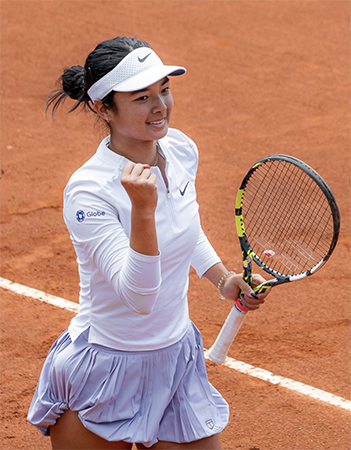
Eala at the WTA 125 Oeiras Ladies Open in Portugal (Source: Alex Eala’s Facebook)
Public discourse has grown accustomed to speaking in the language of constraint: what cannot be done, what must be deferred, what risks should not be taken and increasing polarization. Against this register, Alex Eala’s manner feels almost anomalous. She does not perform smallness. She does not compete as though she represents an exception from a marginal country. She competes as though belonging requires no explanation.
Without intending to, Alex Eala exposes how rare it has become to see Filipinos represented in the world not as petitioners or exceptions, but as rightful participants and competitors. She has upended that assumption.
Globalization Without Apology
Alex Eala embodies a form of globalization that many Filipinos intuitively understand but rarely see affirmed. She trains abroad, competes internationally, and navigates transnational systems while remaining culturally anchored. In doing so, she also comes to represent a young, modern Filipina—accomplished, self-possessed, articulate, mature for her age and at ease navigating transnational spaces without apology or self-effacement.
Alex Eala’s visibility invites ordinary Filipinos into a space that once felt closed not as participants, but as stakeholders in possibility.
This is mobility without erasure. Her pursuit of excellence is still unfolding, while her cultural origins remain present and unforced. For a country whose global presence has often been mediated through labor migration and sacrifice, this distinction matters. Alex Eala does not arrive as a novelty, or as a grateful guest. She arrives as a competitor. That shift subtly reshapes how Filipinos are perceived and how they perceive themselves. Alex Eala’s importance ultimately lies not in what she says about the Philippines, but in what she makes imaginable. Elite spaces are not fixed; they are sustained by habit and expectation. When someone enters them without apology, carrying culture lightly but firmly, those spaces adjust, however slightly. The sampaguita on Centre Court is not a declaration. It is a fact. It is a reminder that Filipino identity does not need to be explained to belong. At a moment when national imagination has grown cautious, even stultified, Alex Eala offers something quieter than victory and perhaps more enduring: the sense that confidence can precede validation, that possibility does not require permission, and that greatness, when it comes, often announces itself first as promise. Cesar Polvorosa Jr. is a professor of economics and international business at a Canadian university. His essays, poems, and short fiction have been published in North American and Asian anthologies and publications, including Likhaan:Book of Poetry and Fiction, The Philippine Star, and BusinessWorld. He was previously an economist at the Central Bank of the Philippines and an AVP at a Philippine bank before moving to Canada. More from Cesar Polvorosa, Jr.
Reordering Confidence




No comments