
The Elderly Filipino Men of ʻAʻala Park
They gathered there daily. Some sat quietly on benches. Others stood in loud, animated conversations. Ilocano, Tagalog, English, and pidgin could all be heard. They laughed heartily, as if they owned the place.
At first, I saw them as old men simply passing the day. In time, however, I realized many were sakadas—first or second-generation Filipino laborers in Hawaiʻi who had come to work in the plantation fields.
Sakada Migration
The first organized Filipino workers arrived in Hawaiʻi in 1906, followed by many more. Most came from the Ilocos region and other poor provinces of northern Luzon. They came out of necessity. Their journey was shaped by economic hardship, land scarcity, and limited opportunity at home. Hawaiʻi promised wages and a chance to support their families back in the Philippines.
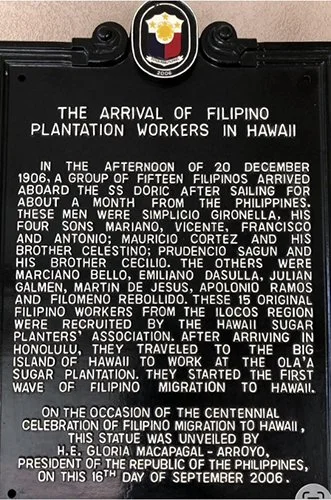
First 15 Sakadas, 1906. Statue created on the 100th Anniversary of the Filipino migration to Hawaiʻi displayed at FilCom Center. Photo courtesy: Author, September 24, 2023.
For many, the journey meant arriving alone or leaving their families behind for years. Because planters recruited men exclusively, workers lived together in bachelor camps on Hawaiʻi’s plantations. There, friendship became a necessity: they cooked together, shared stories, lent money, played cards, and waited for letters from home. In these bonds, they faced a life marked by distance and separation.
As young workers, they entered a plantation economy that required strenuous, disciplined labor. Sugar and pineapple fields demanded strong backs and long hours. The work included cutting cane, clearing brush, digging ditches, loading harvests, and enduring the sun. Housing in the camps was plain. Pay was low. Life was closely supervised.
Yet the sakadas endured because they carried obligations larger than themselves.
Their descendants became teachers, nurses, clerks, soldiers, and public servants. Some entered politics, others formed unions, attended churches, and universities. What stands out is how this presence grew from the margins to a central place in Hawaiʻi’s social fabric. By the 2020 census, Filipinos comprised 26 percent of the state’s 1.4 million residents, making them the largest Asian group and, in numbers, exceeding Native Hawaiians.
Moving out of the Plantation
As plantations slowly declined in the 1990s, Filipino life in Hawaiʻi began to shift from plantation camps to towns and neighborhoods. Workers and their families settled in new communities. On Oʻahu, Kalihi, Waipahu, and ʻEwa Beach became important centers of Filipino life.
Kalihi became an urban home for many new arrivals and established families. Apartment buildings were crowded with kin. Filipino groceries, travel agencies, and churches lined the area. Many homes housed several generations under one roof.
Waipahu carried its plantation history into a new era. Once tied to sugar, it became a residential community. Filipino families bought homes, opened sari-sari stores, and raised children there.
ʻEwa Beach, shaped first by plantation lands and later by suburban growth, drew families seeking better opportunities.
In these places, diaspora manifested as community through everyday cultural expression. It appeared in fiestas, novenas, weddings, graduations, and Sunday gatherings. It was spoken in Ilocano among elders, in Tagalog at public events, and in English among the young. It was tasted in adobo, pinakbet, pancit, and other foods cherished by Filipinos. It filled balikbayan boxes sent home to families and relatives overseas.
The Filipino old-timers were deeply woven into these cultural and social activities. and many others.
ʻAʻala Park as Refuge and Memorial
This is why ʻAʻala Park mattered. It was a place where the aging Filipinos and other retirees gathered to pass the time, carrying forward a world that had vanished. They were survivors of a disappearing social order. In their daily gatherings, one could still imagine the old bachelors of the plantations, now transplanted to an urban park in Honolulu.
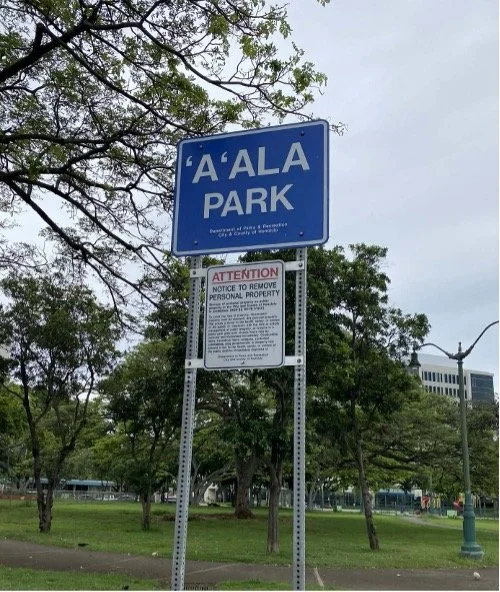
ʻAʻala signboard welcoming visitors (Photo Courtesy of the author, April 18, 2026)
The park became an informal meeting place in downtown Honolulu. The men came not only for shade or rest, but for company. No explanation was needed among them. They shared plantation memories, experiences with luna supervisors, the value of remittances, and deep homesickness.
Many remained single all their lives. Others married late. Some had children who entered a different world—schools, professions, and suburban homes. Their children belonged to Hawaiʻi in a way their fathers never fully did.
But in the park, the manongs returned to one another.
The men spoke of plantation life as if they had left it only yesterday. Their memories remained vivid. They debated Philippine politics. They compared prices in Honolulu. They joked about being single or growing old. They also recalled villages in Ilocos or Cebu that they had not seen in decades.
They carried history in memory rather than in books.
Silence in the Park
I returned in 1990, 2004, and visited ʻAʻala Park again. The manongs gradually disappeared—until they were totally gone.
No monuments marked their departure; their absence itself signaled the end of an era. As age and illness took their final toll, they faded from the scene. What was once a lively gathering of sakada men quietly receded into history, becoming a closed chapter of the past. In their place, the physical landscape of the park also changed. The benches where they once sat were removed and replaced with recreational facilities such as a basketball court and a children’s playground. A large open space remains, now used for adult soccer and baseball games.
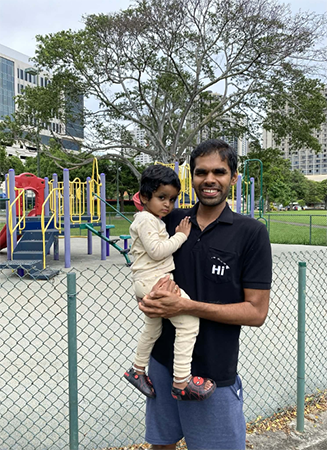
Karthi T. (40 years old), from India, often brings his daughter to play in the park (Photo Courtesy of the author, April 18, 2026)
Their absence affected me more than I expected. It revealed how history is lost from memory or storytelling. A people may remain, even grow stronger, while an early generation slips away unnoticed.
A different crowd began to frequent the park. While some came for the amenities, others were homeless individuals or loiterers seeking a few dollars from passersby. They also included parents who brought their children to play, basketball enthusiasts who competed, and those who simply wanted to rest and enjoy nature.
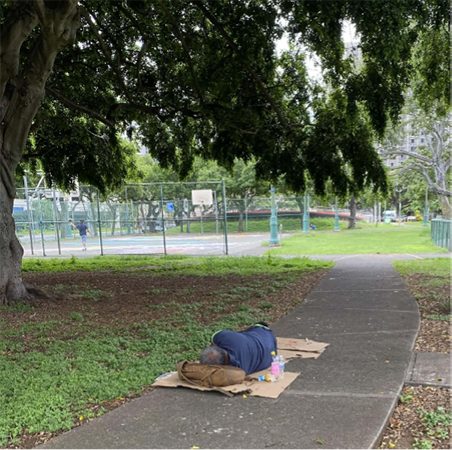
A sleeping homeless man, oblivious to park visitors.
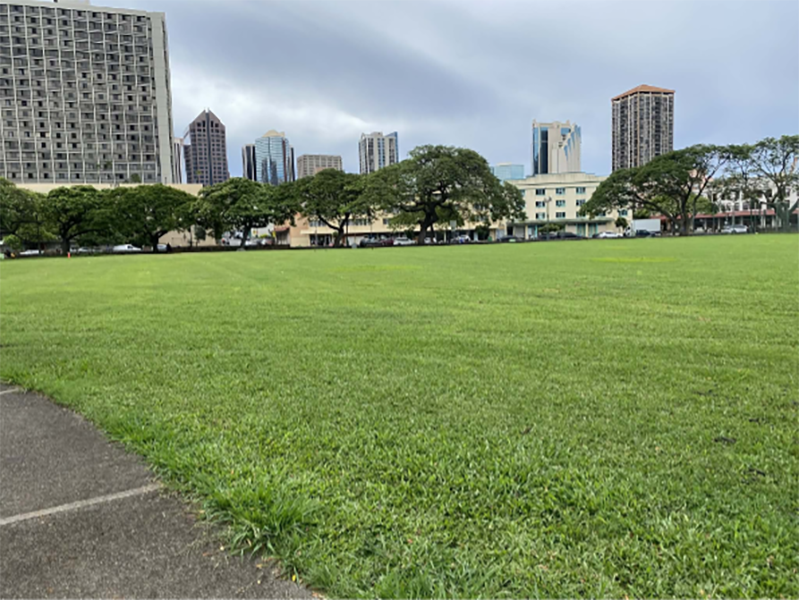
More spacious grounds to play. (Photo Courtesy of the author, April 18, 2026)
Filipinos in Hawaiʻi were very much alive in 2004. They could be seen in Kalihi, Waipahu, and throughout the island. New migrants had arrived. Younger generations were advancing in many fields. The community was larger, more educated, and more visible than ever.
Yet, amid this presence, something could not be replaced: the shared experiences of the elderly Filipinos at ʻAʻala Park.
Memories Live on
Gone were the manongs who told stories about the first ship arrivals, the cane fields, the camp barracks, the first dollars sent home, and the years of loneliness.
I remember them now with greater respect than when I first saw them. At the time, they seemed like old men talking in a park. Now I know better. They were sakadas—pioneers of a bygone era who long deserved recognition. Their presence was not incidental but historical. Their photographs were dusty memorabilia, and their conversations were unwritten history.
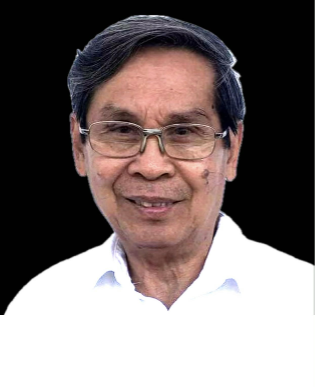
Dr. Federico V. Magdalena is an Associate Researcher and Assistant Director of the Center for Philippine Studies at the University of Hawaiʻi at Mānoa. He serves as a Contributing Writer to Hawaiʻi Filipino Chronicle, specializing in feature articles.



No comments