
The Eye Doctor, the Nurse, and the Fine Print of Aging
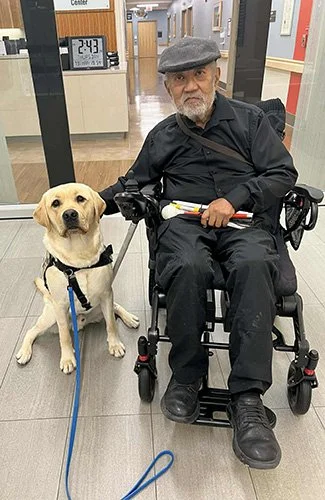
Alex S. Fabros, Jr. (Photo courtesy of Alex S. Fabros, Jr.)
You’re not escaping without a needle.
It’s going somewhere far too close to your eyeball for comfort.
Now, I’ve reached that stage in life where medical appointments feel less like checkups and more like scheduled negotiations with fate. Still, I walked in like a professional—calm, composed, pretending I hadn’t spent the last 24 hours mentally rehearsing how not to flinch.
The surgeon had a new nurse assisting her. Young—about twenty-five. Sharp, efficient, and with that calm confidence that says, I do this all day, you’ll survive. She was Asian, polite, and had that reassuring tone people in medicine develop, like they’re speaking to both you and your anxiety at the same time.
We exchanged a few words before the procedure—small talk, the kind that exists purely to distract you from the fact that someone is about to put a needle in your eye.
And somewhere in that quiet space before the lights dimmed and the chair leaned back, a thought came to me—one that doesn’t leave you as you get older:
Inwardly, I was still a young man.
That part doesn’t age. It doesn’t slow down. It doesn’t update its calendar.
Outwardly, though—that’s another story. The years write themselves across your face, your hands, your gait. The world sees the version of you that time has edited, even while inside, you’re still running the original draft.
Then came the moment.
You sit back. You stare at the light. You try not to think about anything. You fail.
The shot happens.
There’s no elegant way to describe it. It’s quick, precise, and deeply personal—like your eyeball just signed a contract it didn’t read.
Afterward, as I’m blinking my way back into the visible world, the nurse checks in on me.
“You did great,” she says.
That’s when the post-procedure bravado kicks in—the kind that only appears after the danger has passed.
I looked at her and, half-joking, said:
“You know… if I were a few years younger, I’d probably be asking you out right now.”
And I meant it—not just as a joke, but as a quiet acknowledgment of that younger man still standing somewhere inside me, hands in his pockets, ready to take a chance.
Nothing prepares you for being simultaneously flirted with and reassigned to eldercare in the same sentence.
Without missing a beat, she smiles and says, “My mother would like that.” Now that stopped me. Would her mother like that? I paused, looked at her, and said, “She would?” And with perfect composure—clinical, even—she replies: “Yes. You could help change my diapers.” Now, I’ve been in a lot of situations in my life—military, academia, labor camps, you name it—but I can tell you this with absolute certainty: Nothing prepares you for being simultaneously flirted with and reassigned to eldercare in the same sentence. I sat there, one eye still dilated, trying to process what had just happened. Was I just complimented? Recruited? Promoted? Demoted? Somewhere between dignity and dependency, I had crossed a line—and I wasn’t entirely sure which direction. The surgeon, who had clearly heard this exchange, kept working as if nothing had happened. Years of training, I suppose. Surgeons don’t react. They observe. Quietly. Probably file it away under “patient coping mechanisms—unusual but harmless.” And then, as I stood to leave, the nurse gently put her arms around me—close, steady, the way a couple might stand for a moment if the world had slowed down just for them. But this wasn’t that. She was helping an old veteran regain his balance, guiding him carefully and respectfully toward his power wheelchair. And in that quiet, unmistakable way, it told me everything I needed to know. There was a time when I could jump with bravado, oxygen rushing, six miles high. A time when I could run a marathon to prove I could. A time when driving a Porsche at Laguna Seca felt less like risk and more like rhythm. Those days didn’t ask permission. They just happened. Now, I moved carefully. Deliberately. Assisted. I had aged. And somewhere along the line, I realized something else—I would miss it. Not just the speed or the strength, but the illusion that time might be negotiated with. There’s probably a researcher somewhere working on a little pill—something to stretch the years, maybe even promise immortality. I won’t see it. And that’s alright. Because what remains isn’t the body that carried me through those years, but the words I leave behind. The stories. The memories. The pieces of a life are set down carefully so they don’t disappear. That’s what lasts. That’s what I’m working on now. I walked out of that office seeing a little less clearly—but understanding a whole lot more. Aging, it turns out, isn’t just about vision loss. It’s about knowing that inside, you’re still that same young man— and accepting that what endures is not how fast you ran, But what you chose to remember, and what you chose to share. Alex S. Fabros, Jr. is a retired Philippine American Military History professor. More articles from Alex Fabros, Jr.



No comments