
Barong and Filipiniana: A Foreigner’s Altered Impression
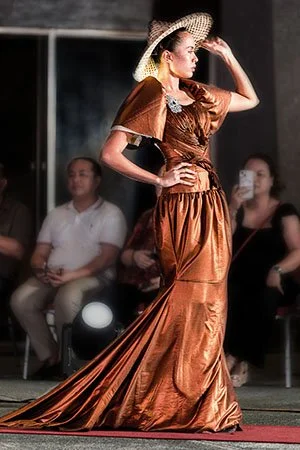
Filipiniana on the Runway
A contemporary Filipiniana shown on the runway, combining traditional silhouette with updated proportions.
Before that, I didn’t even know that the Philippines had a national dress or what it looked like. I first encountered Filipiniana when my former Filipina girlfriend showed me a dress she had rented for a special occasion. She was genuinely happy about it.
“Oh my God,” I thought. Those sleeves looked so strange. What was that supposed to be? That was my first impression. When I cautiously hinted at it, she was surprised and hurt. I think I offended her. I didn’t mean to — I just said what I honestly thought at the time.
My first experience with the barong was not much better. In one store I saw shirts made of semi-transparent fabric and asked a friend what they were. “Barong Tagalog — the national Filipino shirt,” he replied. I stepped closer and touched the fabric. It felt almost like plastic. Most likely, it was synthetic. In a hot climate, it seemed odd. I genuinely didn’t understand how anyone could wear something like that.

Barong Tagalog in Piña Cocoon Silk
Two Barong Tagalog in piña cocoon silk; the right piece features traditional calado integrated into the fabric.
Later, I met Josip Tumapa, who worked as a designer. In the studio, I saw a jacket and heard the same name again — Barong Tagalog. But this one was completely different.
The fabric was soft, with a slight sheen. As I learned later, it was piña cocoon silk. For the first time, I noticed the ornament. It was floral, running across the entire front panel and extending onto the sleeves. Everything looked different from what I had seen in that store.
Gradually, I began to see how varied these shirts could be — from strict, classic versions to more daring and experimental ones. The barong stopped seeming like a strange formality. It was far more complex than I had initially thought.
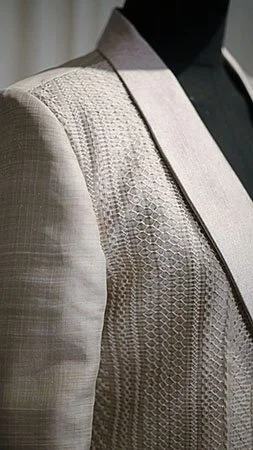
Calado Detail in Piña Cocoon Silk
Close view of calado, where threads are withdrawn to form geometric openings within piña cocoon silk.
Filipiniana was a different story. I rarely saw dresses like that in stores and for a long time considered the style strange. To be honest, I didn’t like it. Most likely, I simply hadn’t encountered works that could change my perception.
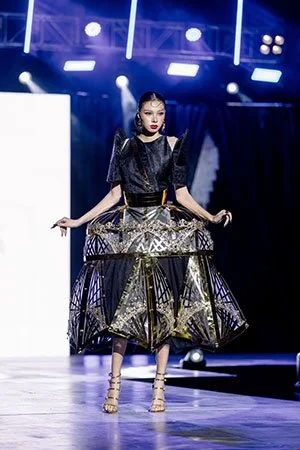
Avant-Garde Filipiniana
An experimental Filipiniana with structured panels and metallic elements.
The turning point came at a fashion show. That was where I saw Filipiniana in very different forms — from traditional interpretations to avant-garde ones. When the models stepped onto the runway, I didn’t immediately realize I was looking at Filipiniana. One look matched the familiar image — with voluminous sleeves and a recognizable silhouette. Another appeared completely different, with bolder construction and unexpected lines. Only later, in conversation with the designers, did I learn that both belonged to the same tradition. I had to ask several times. The difference from the image I carried in my head was that striking.
Over time, I realized that my first impression had been superficial. Back then, I would never have imagined that one day I would want a barong for myself.
That’s when I understood that Filipiniana isn’t limited to a single canon. It can be traditional, or it can take on an entirely different form — with a new skirt structure, altered shoulder lines, and a different architectural balance. Later, I saw many more interpretations, from classic to experimental. Evolving Filipiniana Form Over time, I realized that my first impression had been superficial. Back then, I would never have imagined that one day I would want a barong for myself. Now I find myself choosing the ornament for my future barong — not with irony, but with genuine attention to the details. Anton Dvoryadkin is General Manager at Josip Tumapa Design in the Philippines. He handles international communication for the studio.
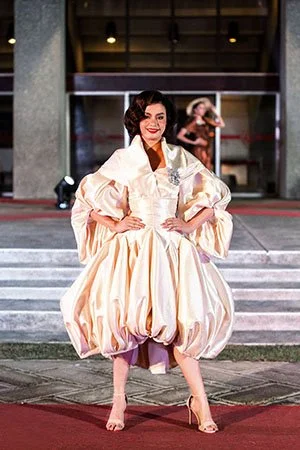
A modified Filipiniana silhouette with altered sleeves and volume.




No comments