
The Locsin Clan: Roots, Philippine Style
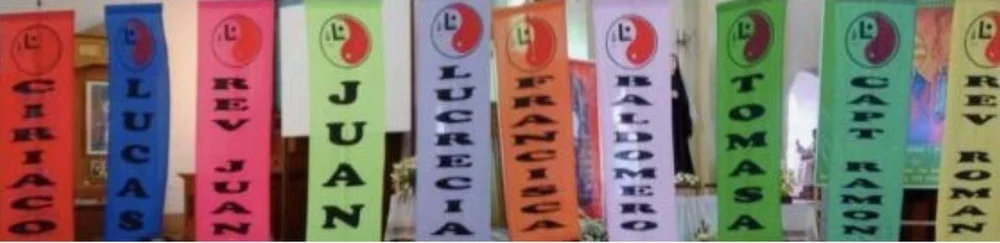
The banners of the ten branches of the Locsin Clan, prominently positioned at the 2010 Grand Reunion of the clan at the Silay City Civic Center, which was attended by over 3,000 descendants of Sin Lok, a Chinese from Amoy (old name of Xiamen) who arrived in the Philippines in 1750 and was baptized Agustin Locsin when he married Cecilia Sayson of Molo, Iloilo, with whom they had eight children thus starting the Locsin Clan.
When Milou brought me to Silay City to meet her extended family in 1972, I learned of the organized listing of the known descendants of Agustin Locsin, a Chinese man believed to have arrived in the Philippines in 1750. He settled in Molo, Iloilo, and eventually married Cecilia Sayson. From that union sprang over a million Locsin descendants scattered not only throughout the Philippines but also in many parts of the world.
The data in the Locsin family tree was obtained from various sources, starting with the notes of the late Dr. Vicente Locsin y Armada of Dumaguete, Negros Oriental. In laying the groundwork, he was ably assisted by the late Don Miguel Unson (husband of Nieves Locsin, a daughter of former Negros Occidental Governor Leandro Locsin).
Subsequently, additional information was dug up from church records, tombstones, public and family documents, newspaper clippings, and data furnished by surviving kin and family friends by means of questionnaires and interviews. Funds for the research and preparation of the initial genealogy listing, and the subsequent publication of the index, were provided by Don Carlos L. Locsin. His daughter, Carmen L. Kilayko, who supervised the initial work, was also commissioned to direct the initial publication of the Family Tree. She was assisted by her daughter, Millie, who served as coordinator.
Many of the later additions to the Family Tree (genealogy listing) were gathered by Gloria L. Locsin (my mother-in-law) and Connie L. Lacson, with additional data coming from the files of Fe L. Unson and her son, Rene L. Unson.
Origin of the Family Name “LOCSIN”
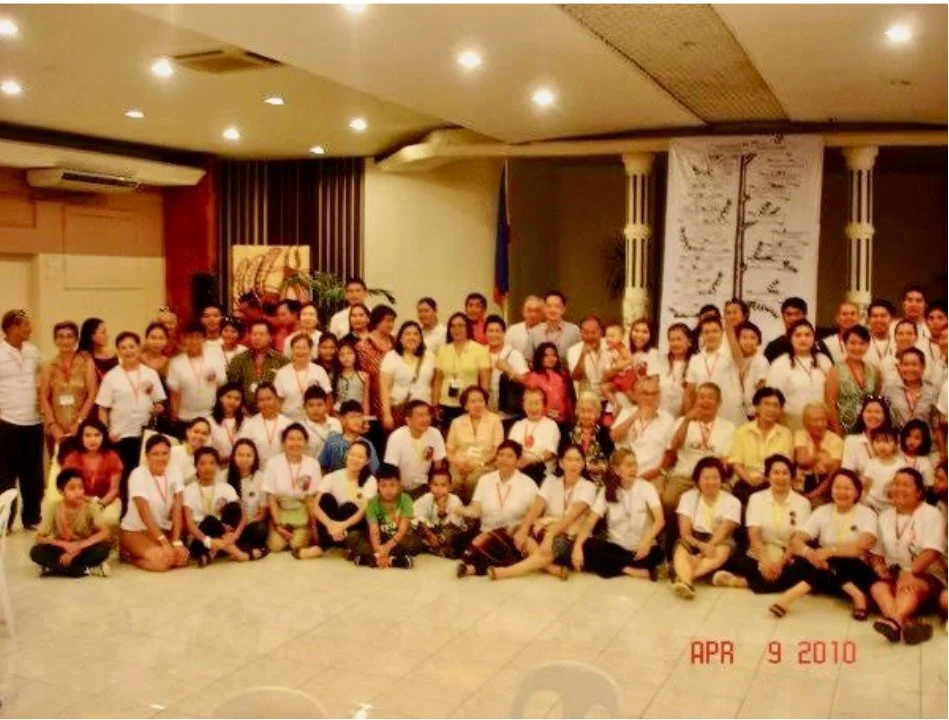
The Ciriaco Locsin branch of the Locsin Clan, one of the Clan’s ten branches. Photo taken at the 2010 clan reunion at the Silay City Civic Center.
A number of documents claim that the family name “Locsin” originally came from a Chinese boy named Sin Lok who arrived in Manila from Amoy (the old name of Xiamen), China, presumably together with Chinese traders, sometime in 1750. He seemed to have traveled alone, as there are no records of other persons with the same surname. He subsequently settled in Molo, Iloilo, and around 1775 was baptized as a Catholic and adopted the name Agustin Locsin when he married Cecilia Sayson, a Chinese-Ilongga mestiza.
According to some officers of the Locsin Genealogy Foundation (LGF), following the Chinese custom, “Loc,” “Lok,” or “Lo” must have been the surname, and “Sin,” “Tsin,” or “Sing” the given name. The LGF says the spelling is of little consequence because the names were written in Chinese and the westernized spelling was, at best, the nearest equivalent. In all existing records, however, the name is spelled L-O-C-S-I-N, and no variation has yet been discovered. The LGF believes that Sin Lok adopted the name “Agustin Locsin” in compliance with a decree by the Spanish colonial government requiring indigenous persons to adopt Christian names.
First Locsin Family
Based on the records dug up by the founding members of the LGF, the union between Agustin Locsin and Cecilia Sayson produced eight children, namely Josef Manuel, Domingo, Juan, Jose, Lucrecia, Ana Maria, Aguida, and Benedicta. Three sons—Domingo, Juan, and Jose—became priests, although Juan fathered a son and two daughters. This original Locsin family provided the foundation and structure for the clan’s genealogy records.
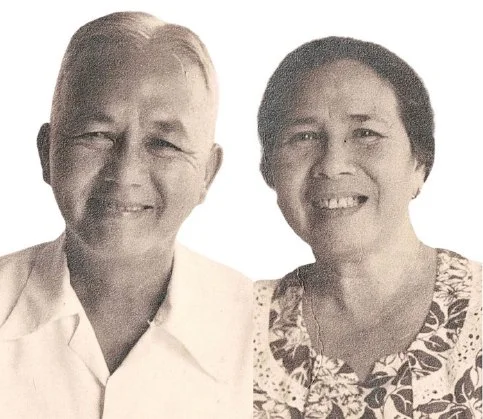
The former Senator Dr. Jose Corteza Locsin and Salvacion Montelibano Locsin, prominent members of the Ciriaco Locsin branch of the Locsin clan.
While Agustin Locsin and Cecilia Sayson started their family in Molo, a large number of Locsin descendants settled in Negros Occidental, particularly in Silay, when the Spanish colonial government opened encomiendas on the island. Between 1767 and 1774, new parishes were established, with Silay being the most extensive, thus becoming the focal point in the evangelization of the north and east sides of Negros Island.
On November 1, 1848, Fr. Eusebio Locsin became the parish priest of Silay, joining his brother, Fr. Roman Manuel Locsin, who was appointed parish priest of Bacolod in 1837. These two brothers, both secular priests, had a great influence on the early flow of migrants, particularly the Locsins, to Negros, especially Silay and Bacolod. Fr. Eusebio invited his relatives and friends from Molo, Jaro, and Miag-ao in Panay Island to come to Silay, and together with the confluence of several factors, they came and gave Silay a unique characteristic that other towns did not have—a cultured class. While others devoted their time mostly to agricultural pursuits, the Silay parishioners took time to engage in literature, music, the arts, and entertainment, as the people also went into business, trade, and industry that gave the town wealth beyond the produce of the land. Because of this, Silay earned the distinction of being called the Paris of Negros. Central to this development were members of the Ledesma, Gaston, and Locsin families.
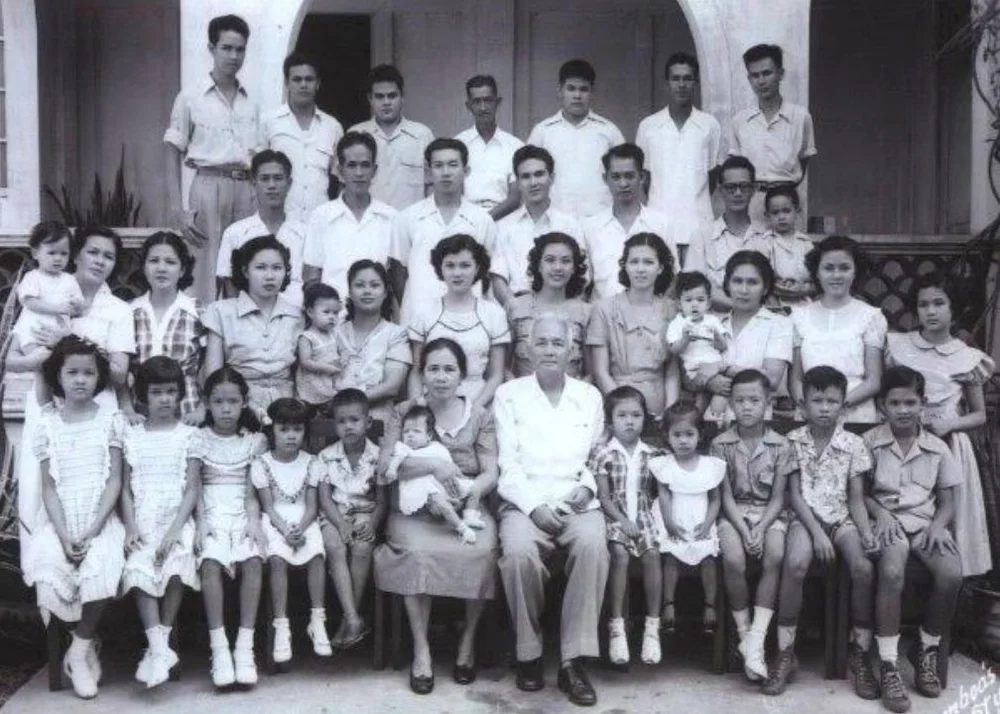
Spouses Jose Corteza Locsin and Salvacion Montelibano Locsin (circa 1950) with their 18 children and their spouses and grandchildren, representing the 6th, 7th, and 8th generation Locsins from the original Agustin Locsin (formerly Sin Lok).
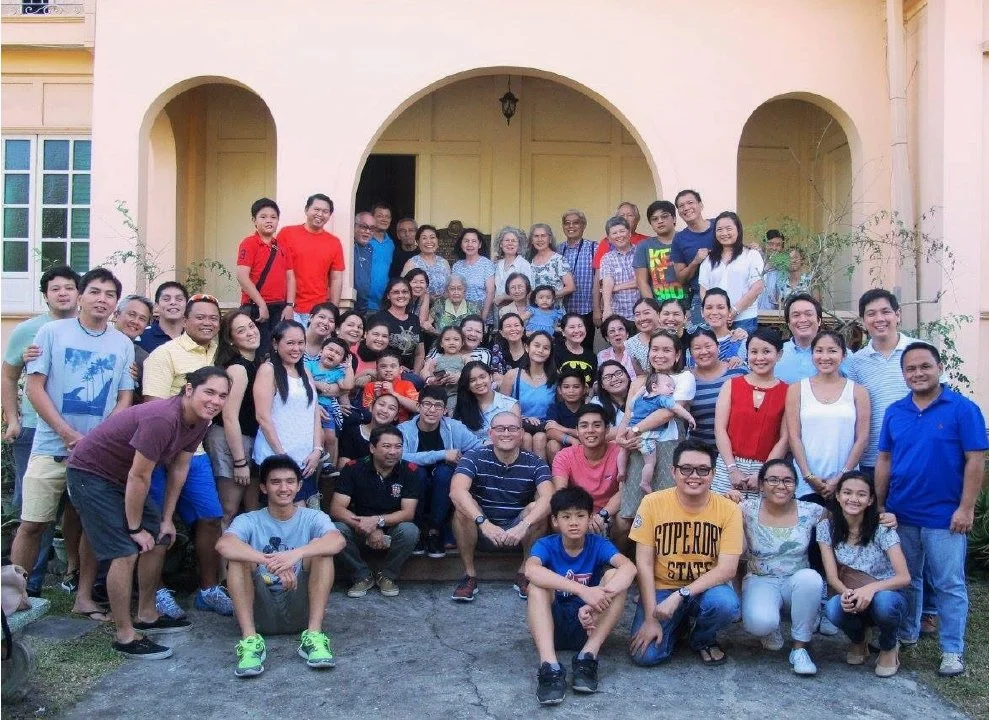
The grandchildren, great-grandchildren and great-great-grandchildren of Jose C. Locsin and Salvacion M. Locsin, representing the 8th, 9th, and 10th generations Locsins, at a more recent reunion at their ancestral home.
The Locsin Clan Today
Based on the numbering system of the Locsin genealogy listing, Agustin Locsin represents the first generation of Locsins, and his eight children comprise the second generation. My wife, Maria Lourdes (aka Milou) Locsin, is already in the eighth generation.
Members of the Locsin clan today are widely recognized as belonging to one of the most organized and influential families in the sugar industry, politics, and civic affairs in the Philippines. The clan considers Silay City its home base, where the Locsin Genealogy Foundation operates a preschool for children of indigent families. Its comprehensive genealogical record listing descendants of Sin Lok (aka Agustin Locsin) includes connections to the Araneta, Benedicto, Colmenares, Diaz, Gaston, Jalandoni, Lacson, Ledesma, Lopez, Montelibano, and Yulo families, among others.
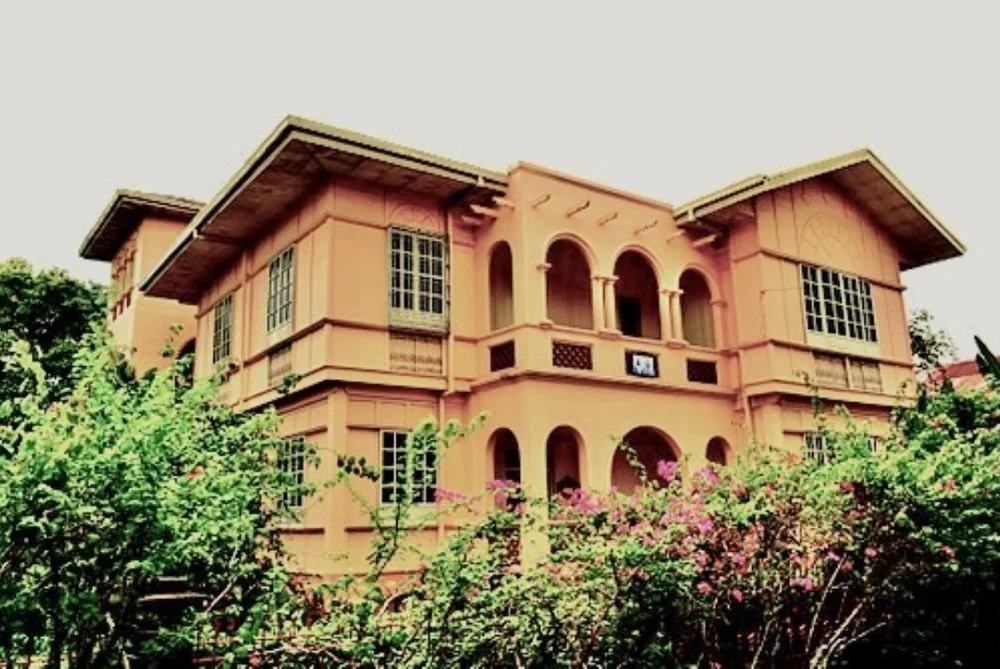
The Jose Corteza Locsin ancestral home in Silay City, one of the many ancestral homes in Silay recognized and registered by the National Historical Commission of the Philippines.
Notable members of the Locsin clan include:
• Dr. Jose C. Locsin (1891–1977): A former senator, medical doctor, and prominent politician from Silay who was instrumental in the country’s adoption of the “Filipino First” policy, and my wife’s maternal grandfather.
• Soledad Lacson-Locsin (1907–1995): A distinguished bilingual writer, editor, and educator, best known for her acclaimed scholarly translation of Jose Rizal’s novels Noli Me Tangere and El Filibusterismo.
• Leandro V. Locsin (1928–1994): A renowned architect and a native of Silay, recognized as a National Artist. He designed the Cultural Center of the Philippines and the Palace of the Sultan of Brunei, among many other notable buildings.
• Teodoro Locsin, Sr. (1914–2000): A distinguished journalist, poet, guerrilla fighter, and former editor-in-chief and publisher of the Philippine Free Press; renowned for his principled opposition to authoritarianism during the Japanese occupation and the Marcos dictatorship.
• Raul L. Locsin (1931–1995): Son of Soledad Lacson-Locsin, a pioneering journalist and publisher who founded Business Day, the first business daily in Southeast Asia. A recipient of the Ramon Magsaysay Award for Journalism in 1999.
• Celia Diaz-Laurel (1928–2021): A popular theater actress and singer as well as an accomplished painter; served as the Second Lady of the Philippines from 1986 to 1992 as the wife of former Vice President Salvador Laurel.
• Jesusa Levy Sonora (aka Susan Roces) (1941–2022): A popular actress referred to as the “Queen of Philippine Movies”; starred in over 130 films during a career spanning six decades. She was married to the equally popular actor Fernando Poe Jr. and was the mother of former Senator Grace Poe.
• Teodoro “Teddy Boy” Locsin, Jr. (born 1948): Son of Teodoro, Sr.; former Secretary of Foreign Affairs and Philippine Ambassador to China; currently Philippine Ambassador to the United Kingdom.
• Agnes D. Locsin (born 1957): A renowned Filipino dance choreographer and a native of Davao City who is recognized as a National Artist of the Philippines. She is known for developing “neo-ethnic” Filipino dance choreography.
The LGF compilers, writers, and other members who collaborated in establishing the Locsin genealogy list and family tree confess to their own lack of formal training and their inexperience in this kind of work. They concede that there is presumably much more unclassified data on the Locsin genealogy that has not come to their attention. They hope that the coming generations of Locsins will be better trained and more energetic in carrying on the work, since no family tree will ever be complete. There will always be births, marriages, and deaths. Maintaining an updated genealogy listing and family tree is a continuing work in progress.
Its comprehensive genealogical record listing descendants of Sin Lok (aka Agustin Locsin) includes connections to the Araneta, Benedicto, Colmenares, Diaz, Gaston, Jalandoni, Lacson, Ledesma, Lopez, Montelibano, and Yulo families, among others.
By reflecting on the Locsin clan’s history, I have come to appreciate that genealogical systems are not simply passive records of descent but rather dynamic forces of cultural continuity and adaptation in response to new challenges. They preserve not just family history but also cultural memory while simultaneously facilitating social adaptation and innovation. Through a brief review of the Locsin ancestry, I now understand that genealogy is essential to cultural evolution, historical persistence, societal transformation, and the construction of a sense of belonging in an increasingly globalized world. In short, we need to know our roots. As the late Dr. Jose C. Locsin stated in his welcome speech at the Locsin clan reunion on September 28, 1974, “. . . what the Locsins have done, particularly in Silay, shows the integrated concept they have of service which ultimately seeks to make people economically stable, culturally active, and spiritually alive; in other words, free and responsible participants in a true democracy.” Nathaniel “Dinky” von Einsiedel is an Architect-Urban Planner and a self-declared adopted son of Silay City, the hometown of Milou Locsin, his wife of 56 years. More articles from Nathaniel "Dinky" Von Einsiedel



No comments