
Life and Death Choices in Bikol in the Dark Years
BOOK REVIEW: Mga Daso: Stories of Martial Law in Bikol; Edited by Soliman M. Santos, Jr, Paz Verdades M. Santos, and Greg S. Castilla; (University of the Philippines Press 2025)
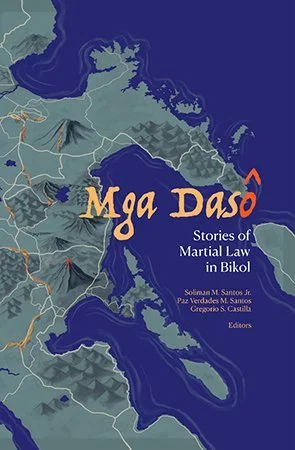
Mga Daso: Stories of Martial Law in Bikol
As one who lived through the horrors of Ferdinand E. Marcos’ martial law, I am eternally grateful for the persistence of the editors in collecting and synthesizing these voices from Bikol heroes whose lives were intimately shaped by 14 years of oppression. A few of these writers have passed on since the book first came out, and others remain frail and no longer remember the details of the past. Thus, the significance of this well-crafted book: the capture of a painful and, simultaneously, joyous era, one that brought out the best in our generation.
For Daso’s memories define who we were, and who we can be in the face of life-and-death choices. We are the stories and myths we construct for ourselves, the struggles we launched and fought for decades, and those we are yet seeking to complete. This book serves as both guide and inspiration.
Daso’s voices come from all corners of Bikol’s wide archipelago—from the Camarines provinces in the north to the outlying islands of Catanduanes and Masbate. If one takes an imaginary stroll through these beautiful islands, one will almost hear the sound of storm-tossed trees, smell the scent of spices and coconut milk, and hear the angry crackling fire of beautiful Mayon.
There are voices from varied perspectives—stories written from the underground, where bonds of the deepest friendship were forged, as well as stories of shocking betrayal; stories written in the fastnesses of the countryside; and stories written from the viewpoints of professionals interrupted from doing the work they did best: broadcasters, lawyers, medics, teachers.
There are stories that map the beginnings of martial rule and the quiet evolution of resistance, grueling stories of the arrest of heroes Atty. Antonio Carpio and Grace Vinzons Magana, whose father died at the hands of the Japanese invaders.
There are stories of the infamous Daet Massacre, in which 35 Philippine Constabulary troopers arbitrarily fired Armalite rifles into a crowd of 4,000 citizens, including women and children, gathered for a political march.
There are stories of People Power, such as that of Y de los Trino. Here, teachers and students guarded ballot boxes at a crucial moment and prevented the stealing of an election. It is audacious and funny at the same time because, in the end, the enemy—the dictator’s soldiers—shared their toothpaste in exchange for food. She can express that unlikely exchange only in the colorful vernacular: “Ta pirang banggi na mayong urulian, mayong karigusan” ("It's been several nights without any sleep or peace.")
This book is made to remember those many unsung heroes and the many moments worthy of celebration. It should be required reading for young people in our secondary schools.
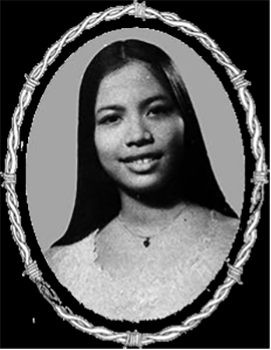
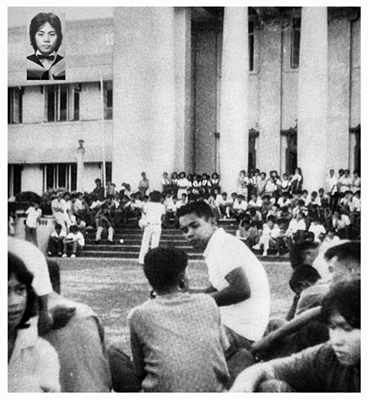
Here are stories told from the viewpoint of the children of activists. Maria Ira Bisuña says that her parents “drew their strength from service—a heavy legacy, I know, but it is now my obligation to carry on …” Another younger woman, Jazmin Badong Llana, wistfully writes, “The grappling with the past will never be over. I was a ‘martial law baby’ and will forever be marked by the experience of struggle against authoritarianism, which continues to this day…” The image of a model father remains with Rebecca C. Torres when she writes, “I attribute my passion for social transformation at a young age to my father’s influence. As children, we sat at his feet as he told stories about heroism, fairness, and compassion. He knew Rizal’s Noli and Fili by heart and would describe people based on characters in the novels.” Here, too, are remembrances of fathers who sacrificed sons to the movement, as when Soliman M. Santos Jr. writes of the martyr Alex Belone’s father, whose words of grief are matchless in their tenderness: “We have done our share in raising a son who loved his country,” Ka Tandis’ father said. “In times of peace, you pay revenues in terms of cash. But in times of crisis, you pay in terms of life. … Kung namatay siya sa fever at hindi namin na-save ay grabe ang aming pagsisisi. Pero namatay siya sa bala para sa bayan, paaanong hindi kami magmamalaki?” (If he had died of a fever, our regret would have been unbearable because we couldn't save him. But he died from a bullet in service of the nation—how could we not be proud?) Lino del Rosario recounts the profound anguish endured by his family as they lived with the uncertainty of never knowing where the remains of his sister, Nona del Rosario, who was killed by the military, were laid to rest. Nona Del Rosario Here, too, eminent professionals recall rough days but still find moments of redemption. Raffy Banzuela describes the “spicy dishes of arrogance and heavy-handedness” of Marcos’ soldiers when they took the radio station he managed off the air. In Camp Canuto Days, Chito R. Irigo recalls that though he was confined to a tiny bartolina inside Camp Canuto, he still saw it as a gift: he was able to do a great deal of reading and was exempted from the prison’s daily weeding. Greg S. Castilla writes compellingly about the short but admirable life of a desaparecido he met in a squatter community in Quezon City. Juan Escandor describes his town’s spiritual tradition and the Gubatnon fiesta in honor of its beloved patron saint, when families renew connections each year with kin, classmates, contemporaries, and friends. Chito Irigo A few names of Bikol heroes are now rightfully enshrined on the Wall of Remembrance at the Bantayog ng mga Bayani in Quezon City. But as Alma Domingo reminds us, for every name written on that wall of heroes, there are countless others “…who will be remembered only by their kin. Or maybe only by the very earth that holds their remains…” This book is made to remember those many unsung heroes and the many moments worthy of celebration. It should be required reading for young people in our secondary schools. The editors say that the initial impulse to publish this collection came from the 2016 book of martial law stories published in Davao—now required reading in Davao high schools—and from the 2022 collection of martial law stories from Cebu. These three regional histories, each unique in its own way, provide a powerful impetus for other regions that served as pillars of resistance to the Marcos dictatorship. It is our hope that, with this excellent compilation, other regions will soon memorialize our people's love of land and language, and the audacity and ingenuity that remain our enduring heritage. Interested persons may view and purchase the book here: UP Press website: https://press.up.edu.ph/product/mga-daso-stories-of-martial-law-in-bikol/ Shopee: https://shopee.ph/product/276147505/42818169660/ Marilen Abesamis is a grandniece of Bikolano heroes General Ludovico and Tomas Arejola, who gave their lives to the nation’s struggle against the Spanish and American colonizers in the 1900s. She is a retired teacher and an energy medicine practitioner. She has a Master in Women and Development from the Institute of Social Studies in The Hague and worked at the New York Times in the ‘70s before moving to Mindanao, where she taught writing and communication skills to farmers, workers, and students during martial law.



No comments