
My Own Personal Masbate
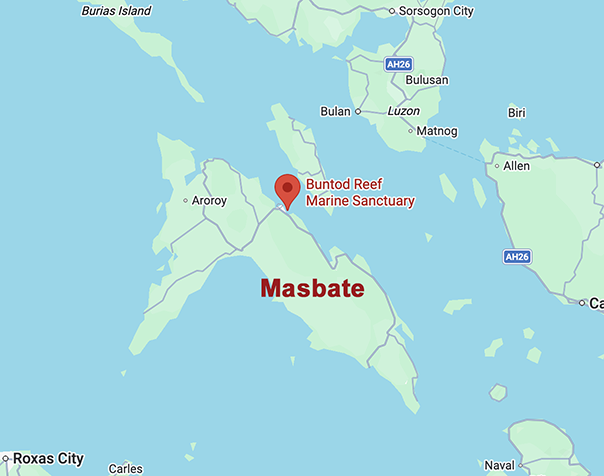
Masbate Island (Source: Google Maps)
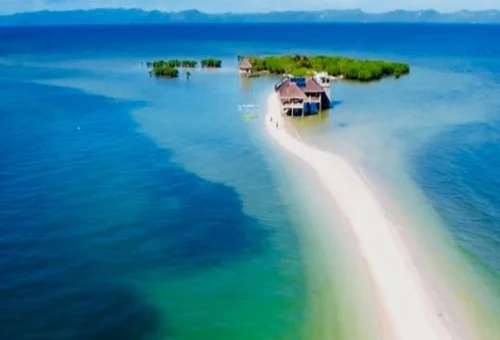
A Youtube photo showing an aerial view of Buntod Reef Marine Sanctuary and Sandbar. It is a stunning marine protected area known for its white sand and crystal-clear waters perfect for snorkeling, diving, and swimming. It is a 10-15 minutes boat ride from Brgy. Ibingay in Masbate City.
Masbate Province sits at the crossroads of geography and culture – where Luzon ends and the Visayas begin. The capital city, which shares the province’s name, is my hometown. Nestled on Ibingay Street, our old family home rests where the road meets the sea. During high tide and monsoon rains, the surroundings transform into a shimmering pool, making the house look like a floating casino at night when the lights are on. Back then, only a pathway of coral rocks connected us to the main road. Running parallel to the road is the airport runway, cutting across the landscape and terminating right at the water’s edge along the very same shore.
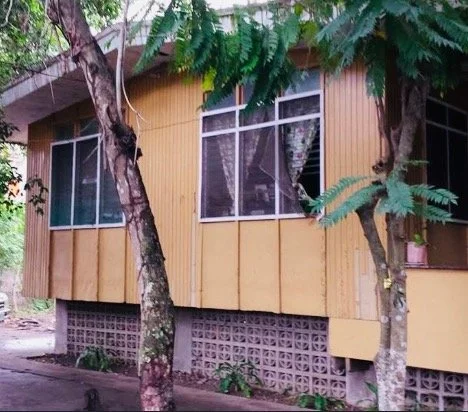
A photo of the old family home on Ibingay Street, Masbate City. The concrete structure at the base of the house was built to elevate it and withstand the rising waters during high tide and monsoon rains. The coral rock pathway that connected the house to the main road is now gone, as the whole property was later filled with soil and gravel.
The city is also home to Rodeo Masbateño – an annual summer festival celebrating the province’s rich cattle industry and cowboy culture. I have never actually experienced the festival myself. By the time it kicked off in 1993, I was already in college and living in Manila. Over the past three decades, I’ve only managed to visit less than a handful of times, usually during the Christmas holidays. What I do remember is that, while my father didn’t own a cattle ranch, he did own three yearlings for a time. They were given to him as gifts - or perhaps as payment for attorney’s fees. I also remember the jingle of our sole local radio station at the time. It went exactly like this: “The cattle country, in the island of Masbate…”
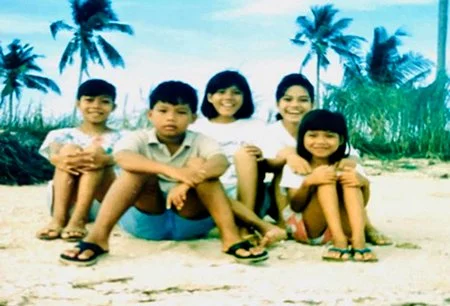
A summer day in 1988 on Ibingay Beach, now part of Jesse M. Robredo Boulevard, just a short walk from home. The author sits in the middle of the second row, sharing a warm afternoon with her siblings - Antoine and Maria Andrea in the front row (left to right), and Maria Anette and Maria Harriette in the back (left and right).
But the Masbate I remember is not the same as the one that stands today. The slow creep of modern development has reshaped its face, trading stretches of sandy beach for concrete and chirping of birds for the restless hum of machines. The vast open space on the beach where we used to play and bask in the sun is now occupied by hotels, restaurants, bus terminals, and other structures. In those days at high tide, the sea rushed in to submerge the shore where we would lose ourselves in the cool, translucent depths. And as the water recedes, low tide strips the sea floor bare, prompting a quiet, bent-backed humility as we begin manguha san sigay, the playful gathering of seashells.
The places that once felt endlessly pristine and alive now seem smaller, diminished, as though something essential has been taken away. I cannot help but feel heartbroken watching these changes unfold, as if I am witnessing my home fade into memory, a place that once offered a tranquil retreat.
The beach lies along the stretch of coastline off Masbate where former DILG Secretary Jesse Robredo’s ill-fated plane crashed. The once tranquil beach has transformed as a busy seaside artery linking people and commerce toward the province’s bustling ports and open skies. Mangroves are protected within Mangrovetum Park located along the boulevard – an LGU-led drive to rehabilitate the mangroves and other coastal resources. The main seaside boulevard is now officially named after him – Jesse M. Robredo Boulevard.
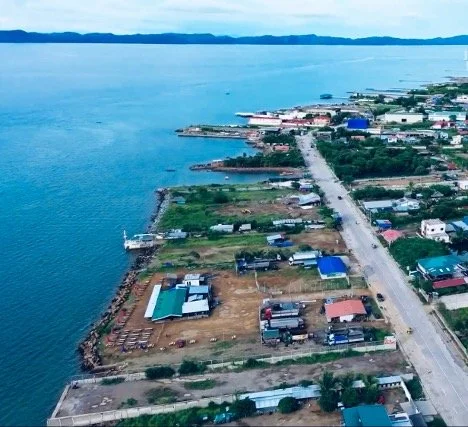
A Youtube photo showing an aerial view of Jesse M. Robredo Boulevard in Masbate City.
Because of Masbate’s geographical location, it has long been a rich, multilingual tapestry. While Masbateño or Minásbate serves as the primary tongue around the capital, a fluid collection of other languages shifts depending on the area of residence, pulling in threads of Bicolano, Cebuano, Hiligaynon, and Waray. I remember a joke from my youth that captured this fluid landscape: they said that in Masbate, the language you speak depends entirely on the direction you are facing. To turn south was to invite the cadence of Cebuano or other Visayan tongues; to face north was to answer in Bicolano; to turn east was to whisper in Waray; and to turn southwest was to speak Hiligaynon. It was a place where local horizons dictated the voice, even as Tagalog and English carved out their necessary spaces in schools, government, business, and everyday interregional communication.
Back then, Minásbate was the undeniable thread that unified communication across the province. Returning now, however, I am caught by surprise at how widely Tagalog has claimed the city’s public spaces – it dominates the conversation in restaurants, shopping malls, grocery stores, hotels, pharmacies, and hospitals. Even the radio DJs broadcast in mix Tagalog and Minásbate, as if the local media outlets have collectively defaulted to a metropolitan script.
The shift isn’t just linguistic. The city’s streets reveal a stark divide on the asphalt the moment one steps out of a vehicle and onto the pavement. Both private motorized vehicles and traditional tricycles unite in a bipartisan effort to saturate the streets with a shared, suffocating blanket of toxic emissions, making a stroll on the sidewalk a hazardous ordeal for the lungs. Back then, we can take a 15-minute relaxing walk to and from St. Anthony de Padua Cathedral for the Sunday Mass. Now, even a short walk to Social Center, a large open-air area to relax, exercise, and socialize, about 450 meters from our house, makes you endure a visceral assault on the senses due to the thick gas emissions, and forces you to play a high-stakes game of survival against the oncoming traffic. The pedestrian have been thoroughly conquered by a dense volume of vehicles using them as parking lots, forced structural blockades, and territorial stray dogs.
There is a quiet dissonance that settles in when I walk those familiar streets now. The buildings have been replaced, repainted, or repurposed, but beneath the surface, everything feels strangely unchanged. It is as if time moved forward physically, yet stood still in spirit. I searched for something recognizable – not in the structures, but in the rhythm of life, in the way people speak, think, and relate – and what I found left me unsettled. The place I once knew exists only as a memory, and I no longer know how to live in what has taken its place.
In fact, what deepens this feeling are the actualities - the same conversations echo, the same habits persist, the same perspectives remain firmly rooted. Having spent so many years away, my mindset has stretched and shifted in ways that feel incompatible with what I encounter here. It is not a matter of right or wrong, but of distance. It is an invisible gap that makes even the simplest interactions feel heavy and strained, as though I am translating myself constantly – speaking words they understand, yet carrying a worldview that remains entirely foreign to the place I once called home.
Even the food, once a source of comfort and identity, has lost its hold on me. Dishes I used to crave now feel heavy, both in body and memory. Perhaps it is my lifestyle that has changed, or perhaps it is something deeper – a subtle detachment from the version of myself who once found joy in these flavors. What used to feel like home now feels strange, and I am left wondering whether it is the place that has changed, or me.
The loss of my parents has left a hollow space that no place can fill. Their absence lingers in every corner of memory – echoing in the rooms of our house in Ibingay, in the routines that no longer exist, in the warmth that has faded into something distant. I find myself missing the simple, vivid details that once filled our days – the savory aroma of garlic and vinegar in Mama’s adobo, and the wood-fire smokiness of Papa’s sinugba na pakol. Most of the time, with quiet generosity, my father would buy everything inside the fisherman’s basket. It was a gesture that brought a comforting abundance to our kitchen – a direct, unvarnished connection to the island’s resources where dinner was never a commodity bought from a sterile shelf, but a gift won straight from the hand of the sea. These memories return not just as images, but as feelings, grounding me in a past that feels both abstract and obscure.
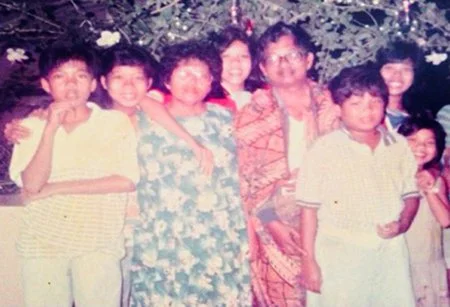
New Year’s Eve in 1988 at the family home on Ibingay, Masbate. Standing left to right: Anthony, Maria Anette, Enriqueta (mother), the author, Antonio, Sr. (father), Antoine, Maria Andrea, and Maria Antoinette. Maria Harriette and Antonio, Jr. are not in the photo.
There is a peculiar grief in realizing that belonging is not something you can simply return to. It evolves just as you do. And sometimes, without noticing, you outgrow the spaces that once defined you. I stand in my hometown not as a part of it, but as a visitor to a past that no longer fits, carrying pieces of it within me, yet unable to place them back where they once belonged.
And still, I carry with me the image of our humble home, where everything began. It was never grand, never more than what we needed, but it held a quiet strength. It taught me resilience, shaped my beginnings, and gave me roots that remain firm despite everything that has changed. In remembering it, I recognize who I am – someone shaped by simplicity, by loss, and by a hometown that will always be both a comfort and a sorrow.
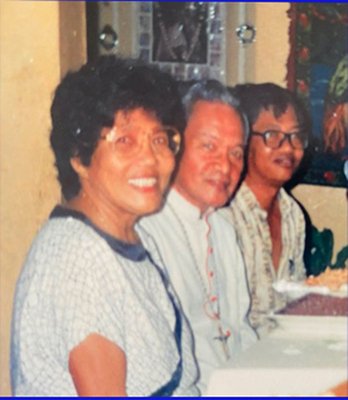
Christmas Eve dinner in 1988 at the family home on Ibingay, Masbate. Seated left to right: +Mrs. Enriqueta Delera Bosa (mother), +Most Reverend Monsignor Porfirio R. Iligan (the first Bishop of the Diocese of Masbate), and +Atty. Antonio Belen Bosa, Sr. (father). Bishop Iligan was always a special guest of the family’s Noche Buena dinner.
I’ve come to realize that time does not simply pass – it reshapes. It carves new contours into who we are, often in places we cannot see until we return to where we began. And in that return, the contrast becomes undeniable. I am no longer the person who left, and Masbate, despite its outward transformations, no longer holds the version of me it once knew. We have both moved on, just not in ways that align.
And yet, beneath it all, there lingers a fragile thread of connection – something that refuses to fully sever. Perhaps it is memory, or gratitude, or simply the knowledge that Masbate, in some irreversible way, shaped me. It gave me a beginning, a foundation, a sense of who I once was. But that thread is not enough to anchor me here anymore. It stretches, thin and delicate, reminding me that belonging is not always about returning, but sometimes about learning how to let go.
On the eve of our departure, my husband was rushed to the hospital with a gastrointestinal concern. The triage area was quiet, and a female doctor examined him. Her demeanor was casual – she sat in a relaxed figure-four position, one shoe kicked off, casually massaging her foot while chatting with us. It wasn’t exactly the medical consultation I’d envisioned, but a crisis has a way of adjusting your standards. Protocol matters very little when you are consumed by anxiety for a person you love. As my husband snoozed behind a privacy curtain, pumped full of IV fluids, I sat alone with my thoughts as time stretched into that heavy, distorted rhythm unique to hospitals at night, punctuated only by the slow drip of the IV and the borrowed fan fighting off mosquitoes.
Driven by restlessness, I stepped into the deserted ward, where the silence was broken only by distant snoring and the unsettling sight of a shape laid flat on the floor, completely covered by a blanket. In a hospital, an unmoving sheet carries an eerie connotation, and a sudden chill of fear sent me retreating straight back to my husband’s bedside. Hours later, anxious for his lab results, I ventured out again and called into empty hallway until two half-awake nurses emerged from behind a nearby curtain. When a knock on the doctor’s office door yielded no response, the nurse casually murmured, “She’s still sleeping, she usually wakes up around six.” I felt a knot of disbelief tighten as we had a flight to catch at ten o’clock that morning.
Silent hours crawled by until a laboring mother arrived to give birth, effectively ending the hospital’s naptime. By seven o’clock, lab tests were clear and we received the formal release clearance. Exhausted but free, we broke away from the facility’s twilight zone, ready for our journey.
I’ve come to realize that time does not simply pass – it reshapes. It carves new contours into who we are, often in places we cannot see until we return to where we began.
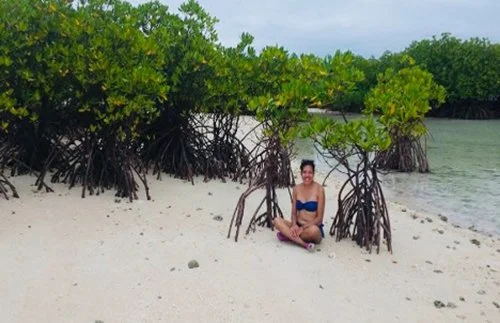
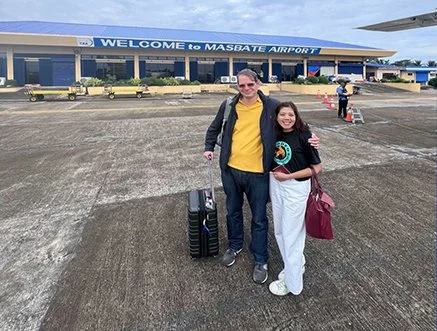
The airport terminal became a gallery of faces from my distant youth. Old faces materialized in the crowd, eyes locking onto mine with sudden recognition. Soon, air filled with the rustle of their speculation: ‘She is the daughter of….’ they murmured, as though my entire family tree had been stamped across my forehead. I met their curiosity with a smile and a gracious nod of acknowledgement and courtesy, sharing a conversation with an old school batchmate who had gone on to serve as the province’s governor. Yet the homecoming remained complex. Beneath the warmth of recognition ran a hilariously predictable undercurrent; there were those who watched me with discerning, critical eyes, trying to calculate my entire life story based solely on the man standing beside me – my foreigner husband. Sensing the heavy gaze, my husband leaned in and whispered, “They look like they’re trying to figure out which planet I came from”. As the plane ascends, hovering momentarily over the island, I am captivated once more by its beauty and simplicity. With eyes brimming, I see katunggan - a mangrove swamp spread across the edge of the shore - while I trace the pristine white sand of Buntod stretches into the blue like a monument in the sea, a solitary witness to both the island’s glorious past and the persistent tide of modernity. The author posed among the mangroves during low tide at the Buntod Reef Marine Sanctuary and Sandbar in 2015. Now I understand that belonging is not fixed. It shifts, just as we do. Masbate, my hometown, is no longer where I fit, not because I have rejected it, but because we have moved in different directions. So, I carry it with me instead – not as a place I can return to, but as a part of my story that lives within me. And in accepting that reality, there is a different kind of peace – not in reclaiming what was, but in letting it remain where it belongs: in the past. The author and her husband Maria Antonia Bosa Van Espen-Boonen is a retired Philippine foreign service staff officer and diplomat based in Brussels, Belgium. Her writing draws on both personal and professional experiences, spanning more than two decades of government service and diplomatic assignments in the United States and in Europe. She is a recipient of the Department of Foreign Affairs 2014 Outstanding Employee Award.



No comments