
Who Will Care for Arnold?
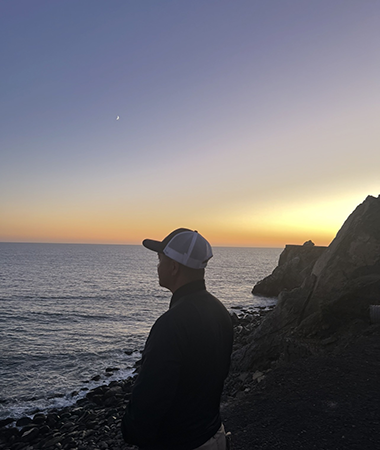
(Photo by Rudy D. Liporada)
Arnold's story came to me through years of family conversations and shared memories. Some identifying details have been changed to protect his privacy.
In his late 50s, he is diabetic and suffers from neuropathy. His legs often go numb. Driving has become painful, yet every morning he forces himself behind the wheel because patients are waiting.
Arnold is a caregiver.
For more than two decades, he has cared for aging Americans in the final chapters of their lives. Some can still walk and hold conversations. Others ask the same questions repeatedly, trapped in fading memories. Some spend their final days in bed, waiting for the inevitable.
Bathing patients is among the easier parts of the job. Other tasks require stronger stomachs and deeper reserves of compassion. Through the years, Arnold has learned the names and purposes of countless medications. He has spent so much time caring for the elderly that he knows the routines of aging almost by heart.
Now he finds himself beginning the same journey.
The difference is that the people he cared for could afford help.
Who will care for him?
For years, much of his work was paid under the table. Other jobs came through agencies that paid little. As a result, he has accumulated neither significant savings nor a pension capable of supporting him when age finally overtakes him.
The irony is painful. He spent decades caring for others yet fears there may be no one he can afford to care for him.
This was not the future he imagined.
In the early 2000s, Arnold jumped ship at a Gulf Coast port.
He had been working aboard a cruise ship as a housekeeper and believed America would offer opportunities unavailable to him back home. The decision was neither reckless nor impulsive. It had been carefully planned by family members who have arrived before him.
An older brother had already left the Philippines and found work as a caregiver. Their mother and sister were already in California.
The plan took months. Long before video calls and social media, the family stitched together Arnold's escape through crackling international calls made on prepaid phone cards. Every minute cost money. Every conversation carried instructions, encouragement and hope.
"I wasn't afraid," Arnold recalled. "My mind was completely made up."
An uncle from Florida picked him up in New Orleans. From there he traveled by train to California, where his mother and sister welcomed him.
His first job was washing dishes in a Filipino restaurant. Within a month, through contacts provided by his brother, he entered the caregiving industry.
He never left.
For more than 20 years, Arnold became part of an invisible workforce that helps sustain America's long-term care system. While families struggled to care for aging parents and grandparents, immigrants like him quietly filled the gap.
Every patient represented both livelihood and responsibility. The death of one client often meant not only grief but weeks of uncertainty before another placement became available.
Today, age and illness are catching up with him.
For more than 20 years, Arnold became part of an invisible workforce that helps sustain America's long-term care system.
Fortunately, life also brought him something he had not anticipated. He married a nurse. Together they built a life. When he is home, Arnold helps with household responsibilities. In return, his wife has become his emotional anchor and practical safety net. "Pero kailangan kong magpatuloy he said. "Nahihiya naman ako sa asawa ko." (I have to keep going. I don't want to let my wife down.) Through marriage, he has obtained health insurance, a driver's license, and a pathway toward legal residency. Yet the process remains uncertain. Completing it may require returning to the Philippines for immigration processing before being allowed to reenter the United States. The prospect worries both of them. Recent debates over immigration enforcement have only heightened their anxiety. News reports about deportations, challenges to immigration status, and efforts to revisit some citizenship cases have created a climate of uncertainty for many immigrant families. Whether every fear proves justified or not, the effect is real. For Arnold and his wife, the possibility of leaving the United States and not being able to return is no longer an abstract concern. Like many immigrants who have spent decades building a life in America, Arnold no longer has a clear place to return to. The grandmother who once anchored the family is gone. Other relatives have passed away over the years. He was unable to attend many of their funerals because leaving the United States could have jeopardized his ability to come back. As the nation debates immigration, border walls, deportations, and legal status, Arnold's story reminds us that behind every political argument is a human being. Home, in many ways, exists only in memory. So Arnold continues. Despite diabetes. Despite the neuropathy. Despite the uncertainty. Every day he gets into his car and drives to another patient who needs help getting through the day. For more than 20 years he has cared for America's elderly. Now he worries about becoming a burden. He asks no favors except for the chance to continue working. And he cannot help wondering: Who will care of him when his turn comes? Rudy D. Liporada was a feature writing instructor in Zambia, Africa before he moved to the US and became a freelance writer/novelist/columnist ("As the Bamboos Sway"). He graduated from the University of the Philippines, majoring in economics. More articles from Rudy D. Liporada



No comments