
Why Baja? Why Not?
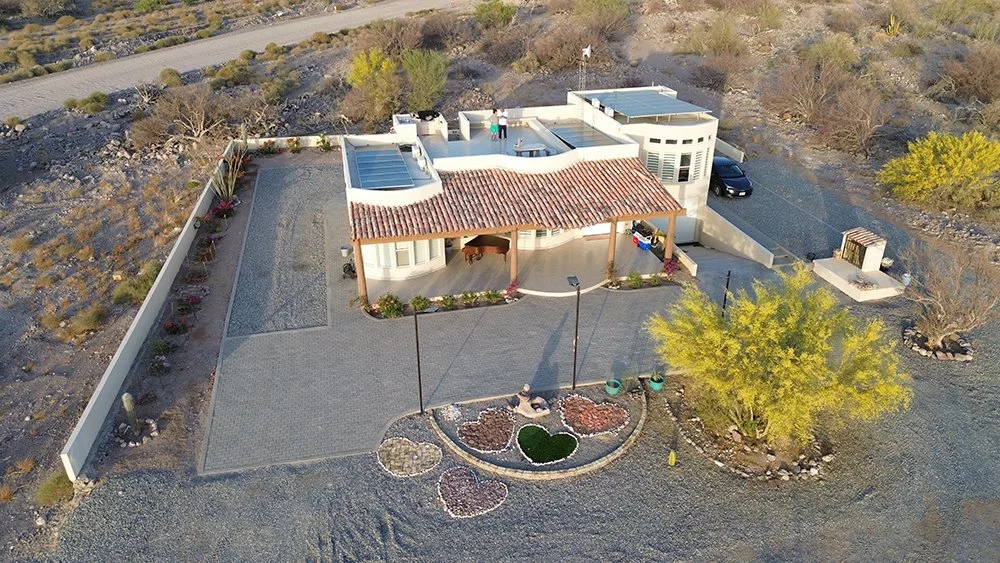
The retirement home of Rudy and Au Liporada in Rancho Costa Verde, San Felipe, Baja, Mexico (Photo courtesy of Rudy D. Liporada)
“No,” I tell them. “They’re afraid to lose me.”
It’s a line that earns a laugh. But it also opens a door to a truth people don’t expect.
I did not arrive in Baja naïve.
Long before Mexico entered our lives, I had already seen how power—both visible and invisible—operates. I saw it as a boy in Baguio City, when my father managed a bowling alley. He was not the owner. Just the man tasked to keep things running, to account for the day’s collections. Yet it was he whom the local racketeers confronted when money fell short. I still remember one moment with painful clarity: a .45 pressed against his temple, his dignity stripped, his body betraying him in fear.
That was my first education—not in crime, but in how ordinary lives become entangled in systems larger than themselves.
Years later, I would recognize the same patterns elsewhere. Different names. Same instincts. Organized power rarely announces itself with drama; it hums quietly beneath daily transactions—through businesses, through labor, through the simple act of people trying to live. In many ways, the modern cartels did not invent this machinery. They refined it. One could argue they learned its rudiments from older syndicates—the Chicago mafiosos who perfected the art of embedding themselves within the veins of everyday commerce, where protection, profit, and survival blur into one another.
So, when people ask me about cartels in Baja, I do not dismiss the question. I simply refuse to see it in isolation.
Life is never that simple.
What I do see, each morning, is the Sea of Cortez.
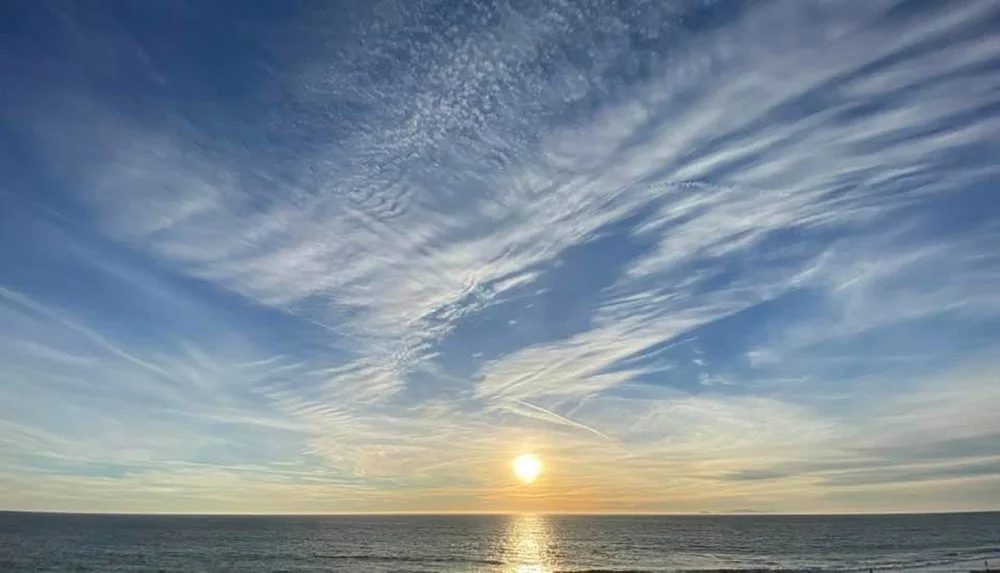
Sunrise we wake up to everyday rising from the Sea of Cortez (Photo courtesy of Rudy D. Liporada).
We built our home in San Felipe on a piece of land that, by California standards, would sound like a clerical error—less than $25,000 for a quarter acre, secured through a fideicomiso, a bank trust that allows us to hold the property and pass it on to our children. On it stands a modest two-bedroom house, with a solar system quietly catching the sun that rises over the water each day.
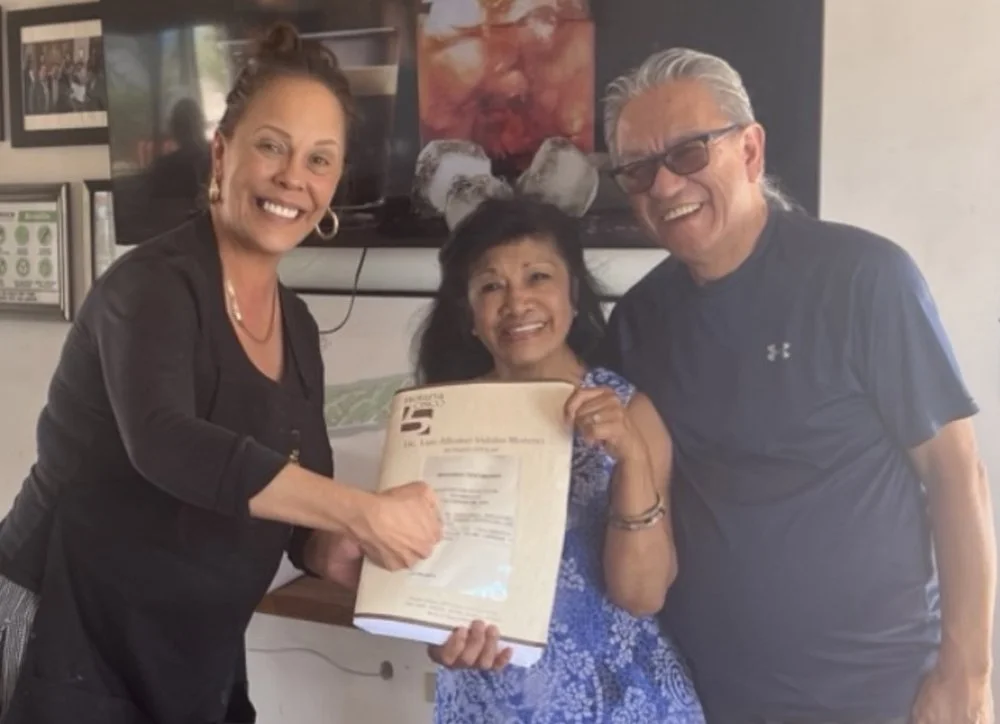
The attached picture shows us receiving our Fediecomiso entitling our ownership through a bank trust - we can sell the property anytime we want or have it inherited by our kids (Photo courtesy of Rudy D. Liporada)..
And that sunrise—how does one explain it without sounding like exaggeration?
No two mornings are alike. Some arrive gently, the sky opening in pale golds and hesitant blues. Others come in bold strokes—reds, oranges, purples—as if the horizon itself were breathing fire before settling into light. In the evening, the performance repeats, but with a different temperament, more reflective, as though the day were exhaling its last colors before surrendering to night.
At night, the sky does something even rarer.
It reveals itself.
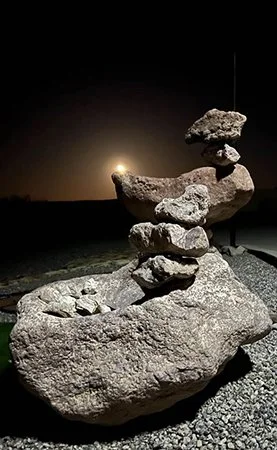
A photo composition of Rudy of a moonrise - porch stone arrangement in front of the Liporadas' home (Photo courtesy of Rudy D. Liporada).
You begin to remember that stars are not supposed to be faint suggestions. They are meant to be seen, to be counted until you lose count, to make you feel both small and strangely accompanied. There are moments when the moon hangs so close you imagine it lowering itself into your hands.
If there is such a thing as quiet evidence of the sacred, I have found it there—not in argument, but in light.
The sea, too, is not simply a view. It is presence. It moves, shifts, offers, and withholds. It teaches patience in ways no sermon ever did. You learn to sit, to watch, to accept that not everything is meant to be controlled.
And for someone who writes, that matters.
Baja has given me something I did not know I needed as much as I do now—solitude that is not emptiness, but space. Here, the hours are not constantly broken by noise, by urgency, by the invisible demands of a life that once felt always in motion. The quiet settles differently. It invites rather than isolates. It allows sentences to arrive without being chased. It lets memory surface at its own pace. In that stillness, writing becomes less of an effort and more of a listening.
But if Baja were only about beauty or solitude, we might still have gone elsewhere.
We had, in fact, already decided—back in 2016—that we would retire in the Philippines. It was a return of sorts, a closing of a circle. We were ready for the distance, even if we did not welcome it. Then came an invitation—a bus tour to see a developing community in San Felipe. Free hotel, free meals, the usual promises that accompany such excursions.
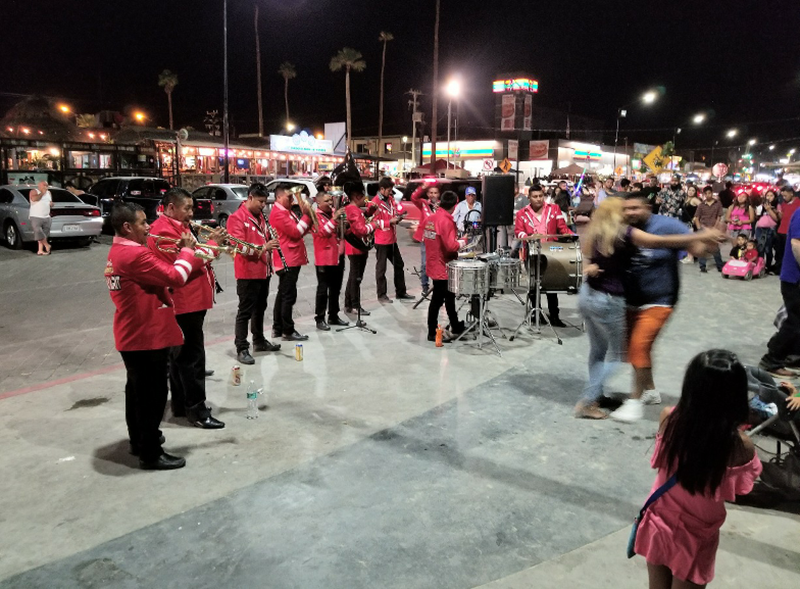
A street night scene every weekend in San Felipe (Photo courtesy of Rudy D. Liporada).
It was not the free offerings that stayed with us. Nor the sales talk.
It was a realization, quiet but undeniable.
At that time, we had eleven grandchildren and one great-grandchild. Today, that number has grown to fifteen grandchildren and eight great-grandchildren. The thought of retiring across the Pacific began to feel less like a homecoming and more like a gradual disappearance—from birthdays, from ordinary weekends, from the small, unremarkable moments that, in truth, make up a life with family.
Baja changed that equation.
From San Felipe, we are still within reach. Not next door, but not distant. A drive away. Close enough that presence remains possible. Close enough that we are not reduced to voices on a screen or faces in photographs sent after the fact.
That, more than anything, anchored our decision.
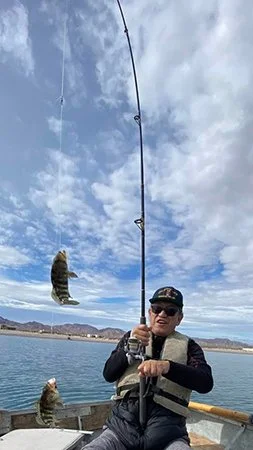
Fishing at Sea of Cortez just by their home (Photo courtesy of Rudy D. Liporada).
There are, of course, adjustments.
You learn that time moves differently here. Mañana does not always mean tomorrow; sometimes it means “not now,” or “when it happens.” At first, it can test your patience. But then something shifts. You begin to see that not everything urgent is important, and not everything delayed is lost. You may grumble about mañana, but you learn to welcome the siesta—especially when it becomes your own.
Life loosens its grip.
And then there is the question that always returns: safety.
“But the cartels?”
I understand the concern. But I also understand how fear is shaped. We grow accustomed to certain dangers and call them normal, while exaggerating others because they are foreign to us. Yet I have seen more headlines of random shootings in the United States than I have felt fear in the daily rhythm of San Felipe.
The sea, too, is not simply a view. It is presence. It moves, shifts, offers, and withholds. It teaches patience in ways no sermon ever did.
Fear, I have come to believe, is often a matter of distance—how far something is from what we know, and how often we are told to be afraid of it. So why Baja? Because here, life has rearranged itself into something both simpler and fuller. Because here, the sky still performs without ticket or crowd. Because here, the sea reminds me that not everything must be conquered to be understood. Because here, solitude is not loneliness, but a companion to thought and writing. Because here, we found a way to remain close to those who carry our name forward. And because, after a lifetime of movement, work, and responsibility, I have learned this: We do not choose a place because it is without danger. We choose it because it allows us, still, to live without fear. Rudy D. Liporada was a feature writing instructor in Zambia, Africa before he moved to the US and became a freelance writer/novelist/columnist ("As the Bamboos Sway"). He graduated from the University of the Philippines, majoring in economics.



No comments