
Steampunk Artist Ram Mallari Is Riding High on His Hyperion
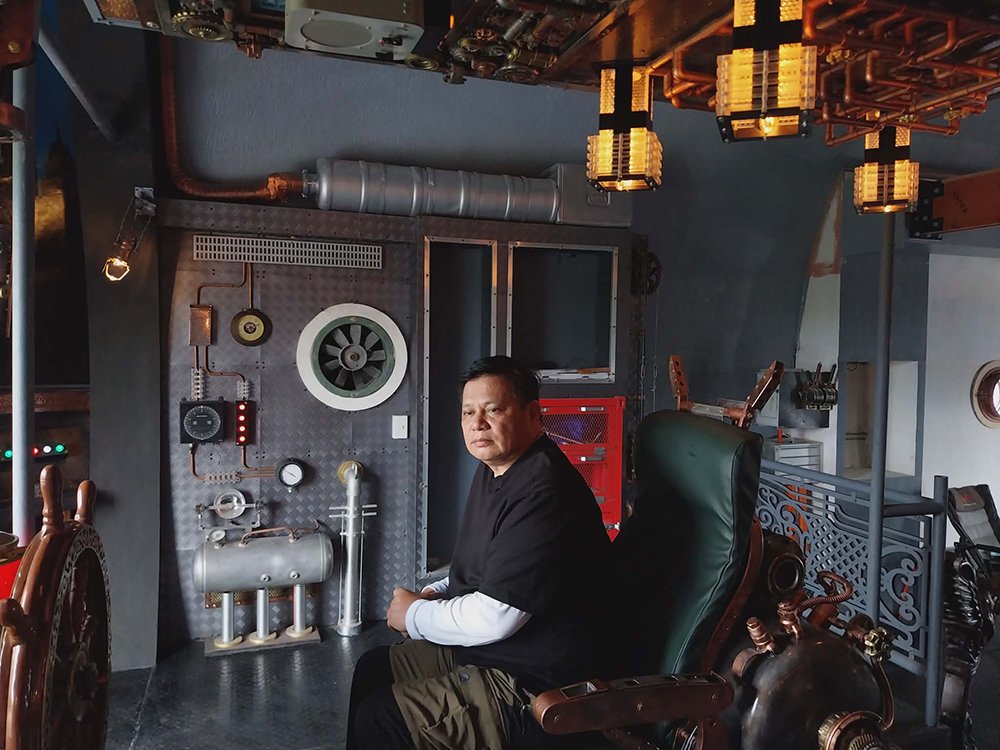
Ram Mallarin inside Hyperion
Steampunk Art
The museum is an astonishing suspended airship—a zeppelin as if it were built during the First World War—which is an element of steampunk, says the museum's builder, Ram Mallari Jr. Known in the art world as a steampunk artist, Mallari is constructing his Hyperion of a museum.
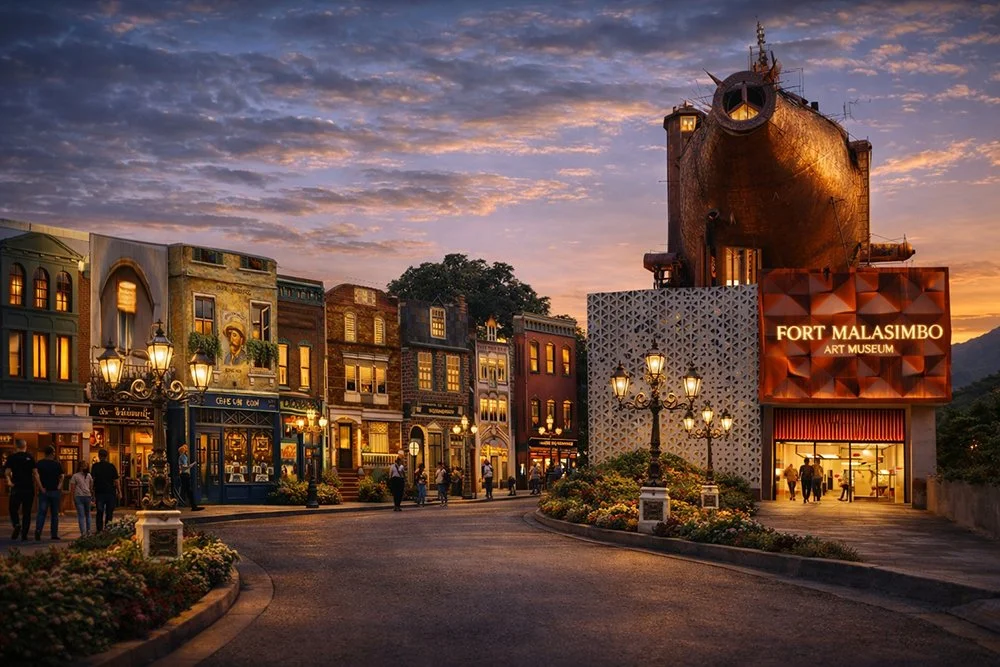
Envisioned Fort Malasimbo Art Museum
Combining elements of Victorian aesthetics with industrial-era machinery and featuring gears, cogs, clockwork, and other mechanical components, steampunk art draws inspiration from 19th-century technology and science fiction. That description, which foreigners used to characterize Mallari's work after seeing his crafts at an international welding forum, fits it to a T.
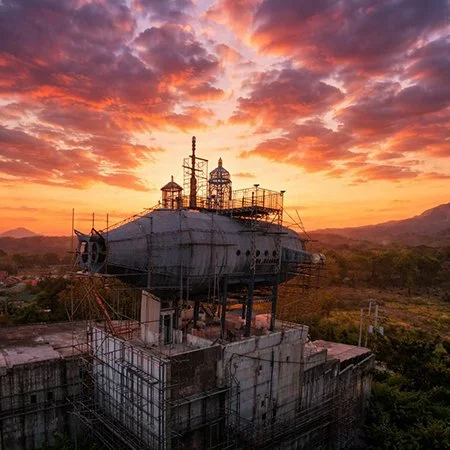
Hyperion at Mt. Malasimbo
Mallari was a second-year architecture student when he decided to work as an OFW in Saudi Arabia. He started as a draftsman but was phased out when automation came in, replacing him with a technician who could manage AutoCAD. He shifted to welding and opened a welding shop when he returned to the Philippines. When there were no job orders, he would use a grinder to craft little items—motors, small helicopters, and the like—fashioned from discarded and recycled metals.
There was a typhoon one time when a media man passing by his shop asked for shelter and to charge his phone. When the visitor saw Mallari's crafted pieces, he invited him to be featured on a radio program to discuss how he was able to create artistic pieces from spark plugs and other junk materials. After the program, a TV personality Mallari met on his way out asked him to be interviewed on television. He appeared on a morning show the following day, which was seen by Thomson Reuters, leading to a more extensive interview. Mallari was also featured on CNN and BBC programs. That was in 2011. It started the ball rolling, and art galleries soon began calling him.
“Hindi ako gaanong nahirapan, although mababa pa ang bentahan noong araw” (I did not really find it hard, although sales were low then), says the craftsman, who quit his day job to become a full-time artist. He was scared at first and thought that if he failed, he would work abroad again. In fact, he received an offer to work in Australia but decided to stay put.
Artistic Accolades
In 2013, when the Ayala Group launched its “Greenstallations” program about nature at its Nuvali estate in the south, it commissioned four artists—Michael Cacnio, Eduardo Castrillo, Juan Carlo Calma, and Mallari. The latter's impressive steampunk sculpture titled The Last Tree depicted a monumental 10-foot robot trying to save the last tree. It took him and a helper six months to complete, but it was well worth it, as the public installation became a big hit.
Meanwhile, his metal sculptures—watchtowers, clocks, steam- and motor-powered vehicles, ships, lampshades, wall clocks, chess sets, reimagined animals, and pop icons—all steampunk creations crafted from iron and metal parts such as industrial pipes, gears from dismantled bicycles and heavy machinery, and steel bolts and rods salvaged from vehicles, became highly sought after by collectors. Men comprise 70 percent of his buyers. The bestseller among his works is his steampunk chest, which is also his favorite.
In 2016, he became the first Filipino artist to appear on the front cover of World Sculpture News. He created a life-sized metal sculpture of Lapu-Lapu, which was unveiled on April 26, 2021, at Camp Crame in Quezon City by the Philippine National Police (PNP) in commemoration of the 500th anniversary of the Battle of Mactan. Crafted from decommissioned firearms, the statue honors the hero whose bravery is symbolized in the PNP seal.

The 1st Filipino Artist cover in World Sculpture News
Third-Largest Jesus Christ Statue in the World
Mallari is currently designing a 140-meter statue of Jesus Christ titled Resurrection, which will be located in Ilocos Sur. Possibly one of the three tallest Christ statues in the world, it will have a chapel, museum, and convention center at its base.
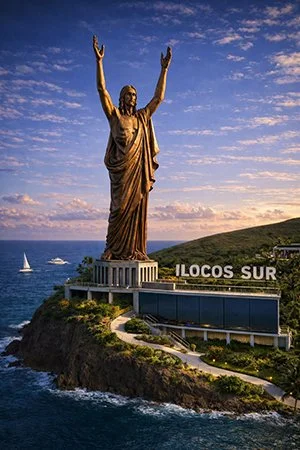
140-foot Resurrection statue of Jesus
His commissioned works continue to increase in number. An eight-seater conference table, for example, is highlighted by a three-dimensional cast aluminum map of the Philippines inspired by Pedro Murillo Velarde's "Mother of All Philippine Maps."
The 3D rendering of the map, according to Mallari, showcases intricate and precise topographical details, capturing the diverse landscapes and terrains of the Philippine islands. It highlights key features such as mountains, valleys, rivers, and coastal areas, providing a comprehensive view of the country's geographical diversity.
He also completed 20-foot copper statues of Andres Bonifacio and Emilio Aguinaldo for the Bagong Kapitolyo in Trece Martires, Cavite. Mallari feels proud that the two Katipunan leaders are finally standing together.
Meanwhile, he also installed a statue of Padre Burgos seated in a park opposite San Agustin Church in Intramuros. He has likewise erected five large installations in Camp Crame and two in Sikatuna.
The National Historical Commission is meticulous in portraying heroes as closely to the truth as possible, including the clothes they wore, according to Mallari. “What I do to inject my steampunk art is to put ‘borloloy’ or decors on the base of the subject, like tables.”
His fame spread, and more international exhibits followed, along with workshops in Singapore, Taiwan, and Hong Kong.
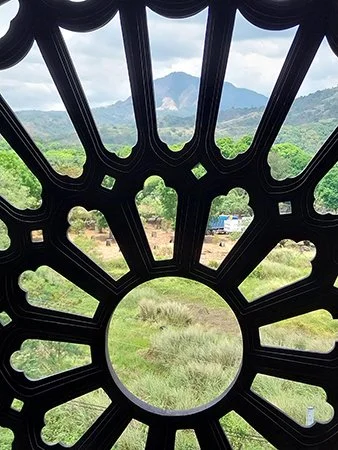
Inside the Hyperion facing Mt. Malasimbo
Pandemic Project
When Mallari bought his property in Dinalupihan at the foot of Mt. Malasimbo, he envisioned building a rest house there. His partner is from Bataan, and the site is near his home province of Pampanga, where he maintains his Northside Art Collective showroom in Mexico.
However, when he looked at the property from a vantage point, he envisioned an airship. Looking toward the side of Mt. Malasimbo, he felt as though the mountain itself was giving him a sign to orient the airship toward it. It was during the pandemic, and business was slow.
One time, he told a client—who had been inquiring about the price of a chest but was taking forever to buy it—that he would give him a discount and place his name on the first post of the airship he was building. The customer lost no time in purchasing the chest. Thirty minutes later, a law student called, wanting to buy a samurai riding a horse. Mallari offered the same deal and said the student's name would be etched on the second post of the airship. Two hours later, the law student called back and said his parents wanted their names placed on the third and fourth posts, so they bought a chest and another item.
Mallari’s metal sculptures—watchtowers, clocks, steam- and motor-powered vehicles, ships, lampshades, wall clocks, chess sets, reimagined animals, and pop icons—all steampunk creations became highly sought after by collectors.
“At the end of the day,” says Mallari, “I think I got something like PhP700K cash.” The next morning, they laid out the airship plans to determine how much metal they could buy with the proceeds and immediately purchased the materials. Many more clients followed, buying artworks with the explicit understanding that their names would be etched on the airship. Mallari says that once the airship is completed, the names of all contributors will be inscribed on a wall as a sign of appreciation for their support. The steampunk artist is very excited to finish his passion project, which will be the largest known steampunk sculpture. He has collected valuable art pieces for a special room in the museum, including a small original Juan Luna painting obtained from a collector in exchange for one of his artworks; works by National Artists such as Jose Joya and H.R. Ocampo; and sculptures by Juan Luna and Tampinco. He also plans to feature young artists to help promote their work. He hopes they will comprise the majority of the museum's visitors. The airship, Mallari's Hyperion, is the main attraction of the four-story museum. The lower ground level, with an open area of 800 square meters, will serve as a park fitted with Ram Mallari's installation art as well as works by emerging artists. Ram Mallari and the author at his workshop Steampunk mural painting is currently being executed in designated areas of the Hyperion. This is intended to avoid overcrowding the interior with excessive mechanical elements while achieving a balanced and cohesive aesthetic throughout the structure. The mural will prominently feature designs that encapsulate the steampunk theme, integrating fantastic cityscapes and imaginative backgrounds to create an engaging environment. Indeed, the steampunk artist Ram Mallari Jr. is riding high on his Hyperion! Alma Cruz Miclat is a freelance writer and retired business executive. She is the president of the Maningning Miclat Art Foundation, Inc., and author of books: Soul Searchers and Dreamers: Artists’ Profiles and Soul Searchers and Dreamers, Volume II, and co-author with Mario I. Miclat, Maningning Miclat and Banaue Miclat of Beyond the Great Wall: A Family Journal, a National Book Awardee for biography/autobiography in 2007. Her third solo book is currently in the works. More articles from Alma Cruz Miclat





No comments